

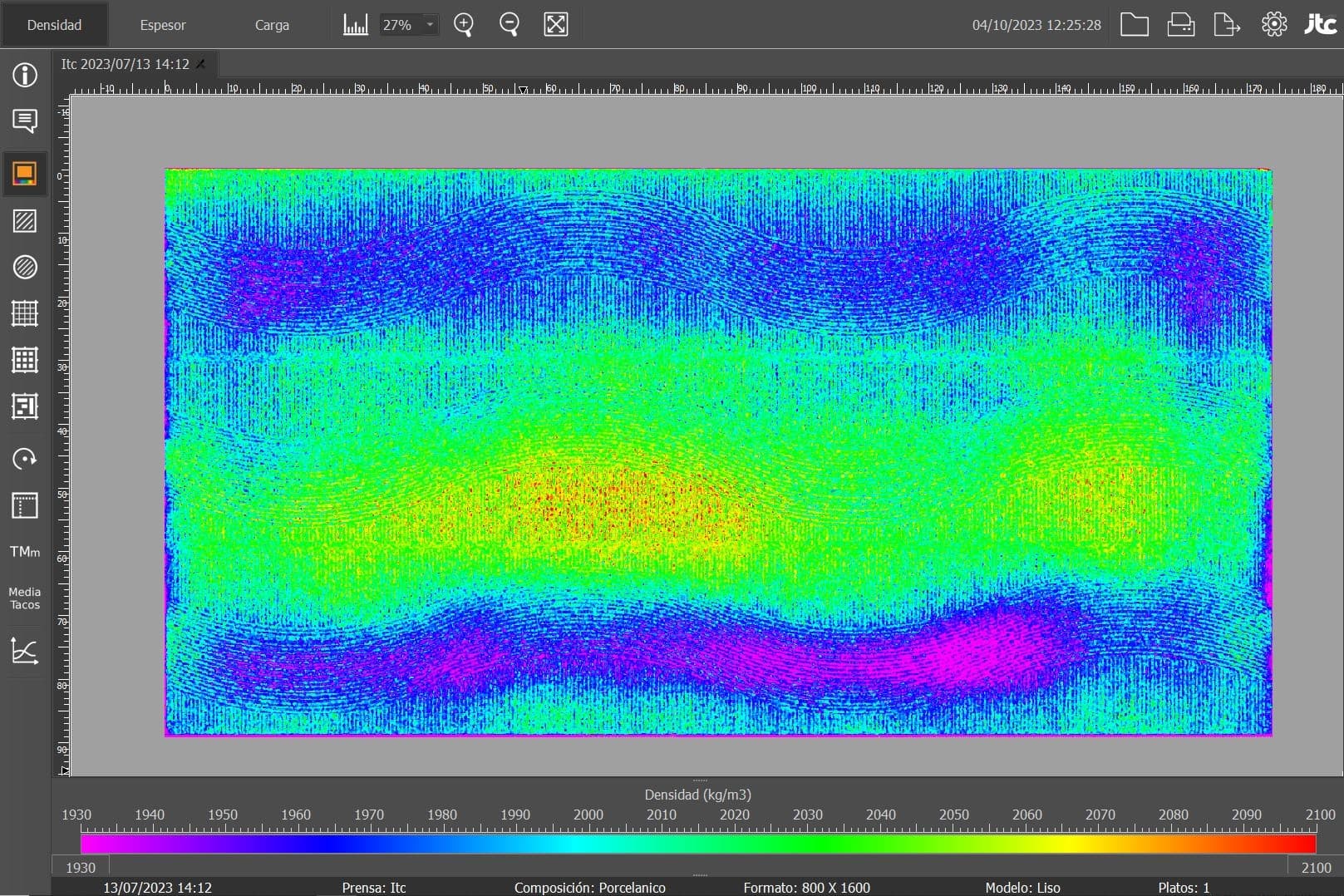
The ceramic industry has been moving towards more connected manufacturing models for years.
Today’s plants record a large amount of information during the process:
- spray-dried powder moisture,
- pressing parameters,
- drying and firing temperatures,
- line speeds,
- energy consumption,
- laboratory results,
- dimensional data,
- final sorting.
This evolution has improved process control and provided a much more complete view of what happens in the factory.
However, there is an important difference between having data and having knowledge.
A factory can store millions of records and still lack the information needed to answer a fundamental question:
“Why did a specific tile behave differently from what was expected?”
This is where one of the great challenges of artificial intelligence applied to the ceramic industry appears.
AI can help find patterns and anticipate deviations, but only if it starts from data that represents the real process.
And that means knowing not only what happened in the machines, but also what characteristics the manufactured tile actually had.
Artificial intelligence in manufacturing: from historical analysis to prediction
Traditionally, many production decisions have been based on analysing historical data.
When a problem appears, the technical team reviews:
- press parameters,
- kiln conditions,
- laboratory results,
- raw material changes,
- adjustments made.
This analysis is still essential.
But the move towards predictive models seeks to answer a different question:
Can we identify the conditions that increase the likelihood of a problem appearing before it happens?
This is the basis of predictive quality.
The goal is not only to detect a deviation once it exists, but to find early signals that make it possible to act on the process.
The limit of using machine data alone
One of the biggest challenges of industrial artificial intelligence is the quality of the data used.
A ceramic factory has a large amount of data coming from equipment:
- pressing pressure,
- production speed,
- temperatures,
- consumption,
- cycle times.
This data is essential.
But it mainly describes one part of the process: what the machine does.
To fully understand final quality, we need to add another dimension: what product has been made.
A press can work within its set parameters and still produce tiles with internal differences.
Dos piezas fabricadas bajo condiciones aparentemente iguales pueden presentar comportamientos diferentes si su compactación no es homogénea en toda la superfície
The ceramic tile as a source of information
To move towards more reliable predictive models, the industry needs to incorporate information on the actual condition of the product.
In a ceramic tile, relevant variables can include:
- density;
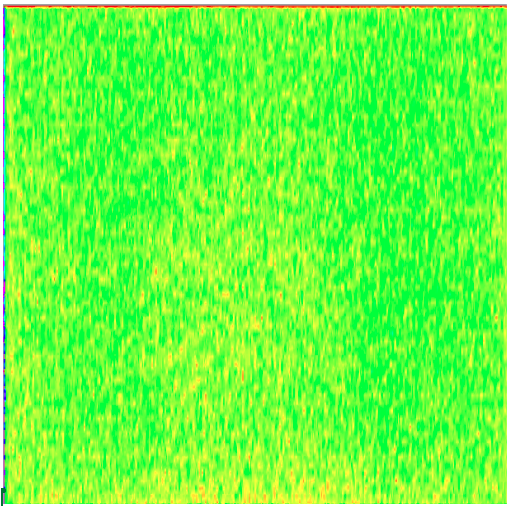
- density distribution,
- thickness,
- mass distribution,
- compaction uniformity.
The difference matters. Knowing this:
“The average density of this production run is correct.”
is not the same as knowing this:
“The density distribution within each tile is uniform and stable.”
The average value lets you monitor trends. The distribution lets you understand behaviour.
An example: when the average hides the problem
Imagine two ceramic tiles with the same average density:
- Tile A. Average density: 2.35 g/cm³. Distribution: uniform across the whole surface.
- Tile B. Average density: 2.35 g/cm³. Distribution: more compacted central area and edges with lower density.
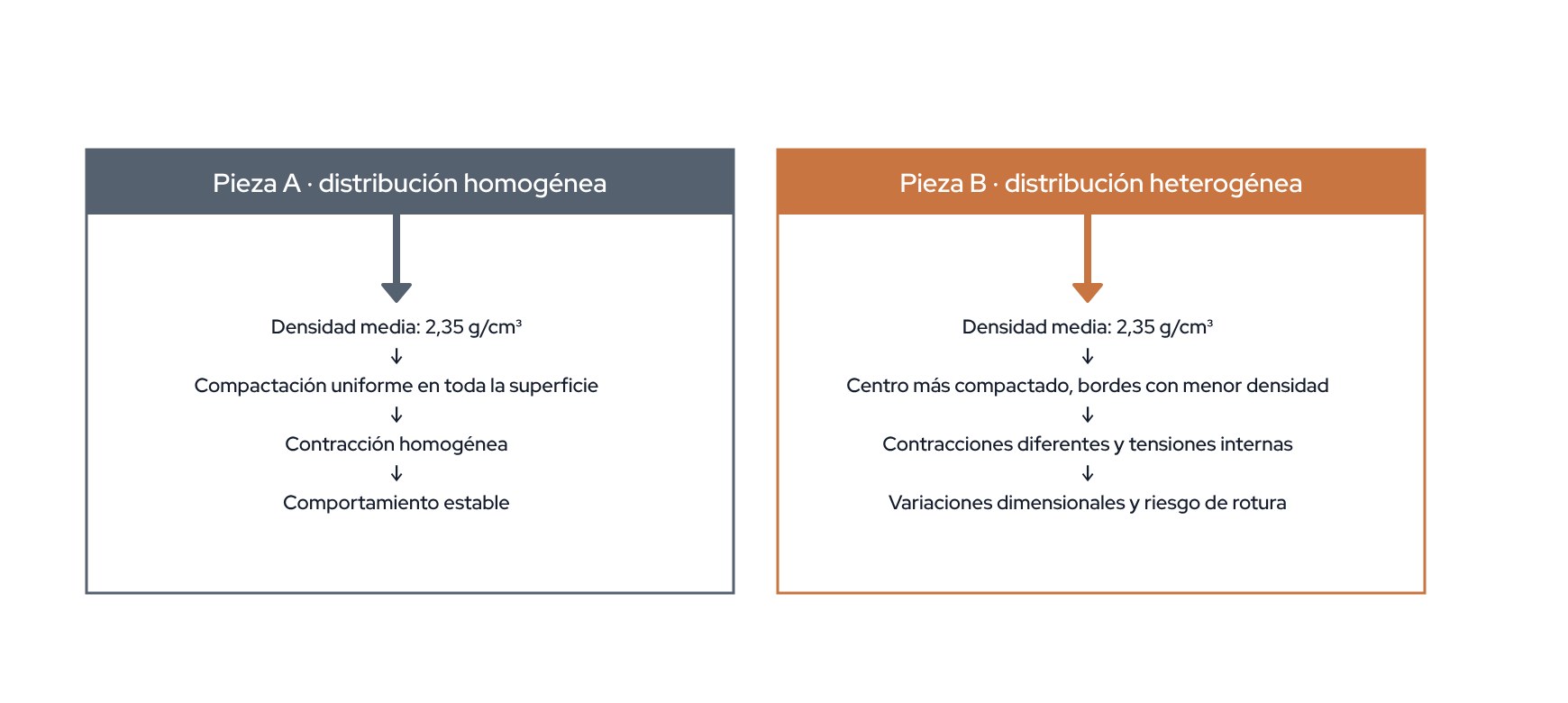
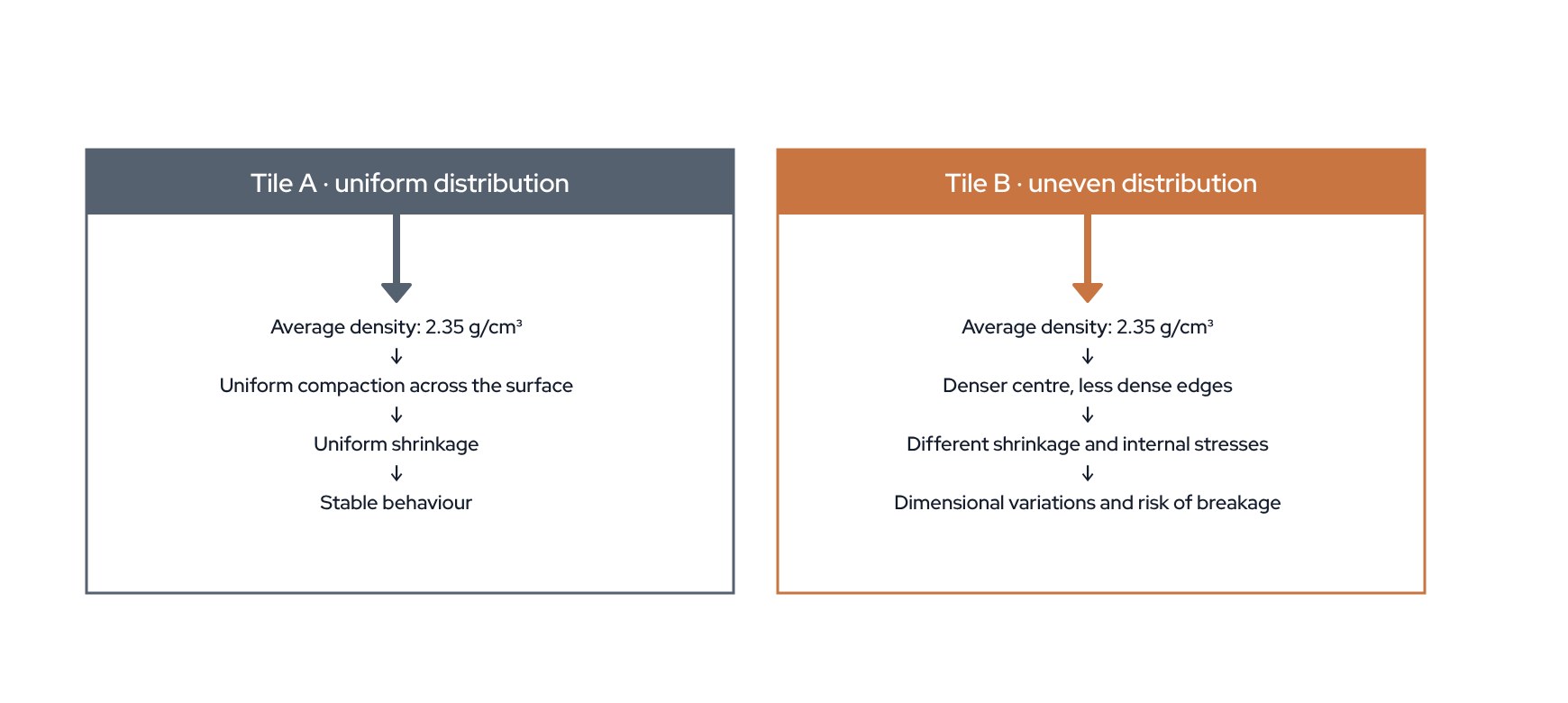
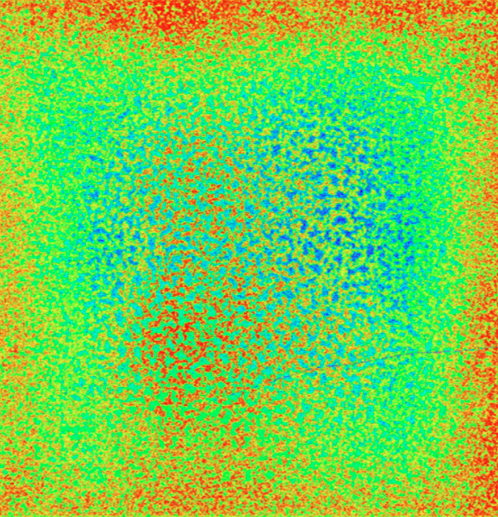
From the point of view of the average, both tiles would be equivalent.
However, during later stages such as drying or firing, their behaviour can differ.
Areas with different compaction can show:
- different shrinkage,
- internal stresses;
- dimensional variations,
- a higher risk of breakage.
For a predictive model, the difference between the two tiles is crucial.
The role of advanced inspection in ceramic artificial intelligence
Artificial intelligence models need quality data.
In the ceramic industry, this means combining:
- Process data
- Product data
- Final result obtained
Tekinn’s advanced inspection technology provides information on the tile through complete maps of:
- density;
- thickness,
- mass.
This information makes it possible to analyse not only whether a tile complies, but how it was formed.
In addition, because the inspection is non-destructive, it is possible to gain knowledge of the product without removing it from the production flow.
From detecting the defect to understanding the process
Artificial intelligence has great potential for the ceramic industry, but its value will depend on the quality of the information available.
The future is not only about installing more sensors or accumulating more data.
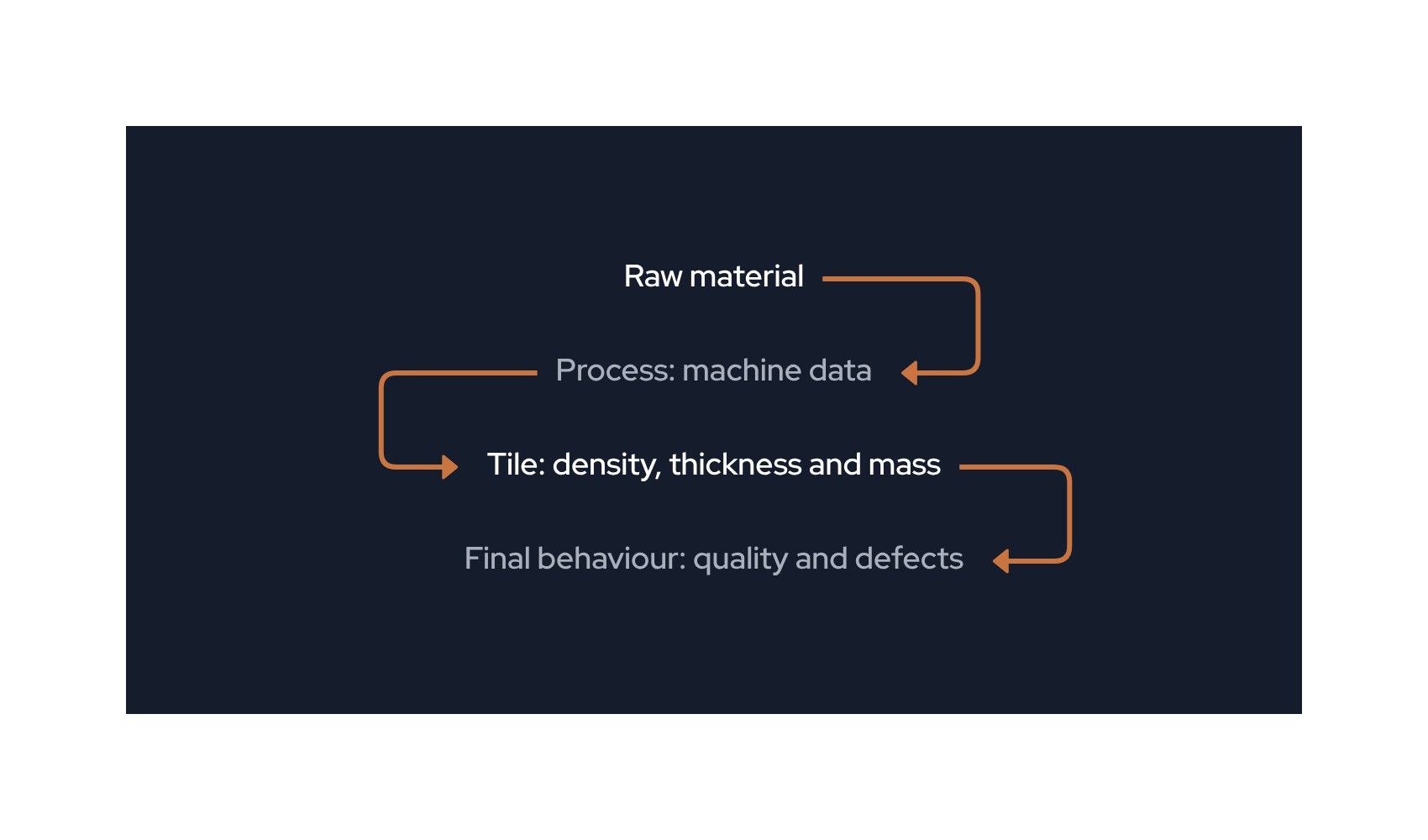
It is about correctly connecting: raw material → process → tile → final behaviour.
AI will be a key tool for moving towards more efficient and predictive factories.
But before predicting what will happen, we need to better understand what is happening inside the tile.
At Tekinn we work precisely on that information layer: turning a ceramic tile into technical data that helps to understand the process and make better decisions.
Because predictive quality begins long before the defect appears.
Technical sources
- ISO/IEC 42001:2023. Information technology — Artificial intelligence — Management system. It sets out the requirements for establishing, implementing, maintaining and continually improving an artificial intelligence management system. It is a particularly useful reference for framing the responsible, traceable and reliable adoption of AI systems in organisations. ISO/IEC 42001:2023 – ISO
- ISO/IEC 23894:2023. Information technology — Artificial intelligence — Guidance on risk management. It provides guidelines for identifying and managing risks associated with the development, production, deployment and use of artificial intelligence systems. It is relevant to the need to assess the reliability of AI systems applied to industrial environments. ISO/IEC 23894:2023 – ISO
- National Institute of Standards and Technology (NIST). (2026). 2026 Roadmap on Artificial Intelligence and Machine Learning for Smart Manufacturing. It analyses the application of AI and machine learning in smart manufacturing and identifies as challenges the management of large volumes of industrial data, the integration of heterogeneous systems, reliability, explainability and the measurement of manufacturing processes. 2026 Roadmap on Artificial Intelligence and Machine Learning for Smart Manufacturing – NIST
- National Institute of Standards and Technology (NIST). (2025). How to Find the Right Balance of Data for Your Industrial AI System. It specifically addresses the importance of the data used to train, test and deploy industrial AI systems, highlighting the need for data to represent real manufacturing conditions and adequately cover the use case. How to Find the Right Balance of Data for Your Industrial AI System – NIST
- ASEBEC / Instituto de Tecnología Cerámica (ITC-AICE). ASEBEC 4.0 Guide. A sector-specific document for the digital transformation of the ceramic industry. It covers data capture and contextualisation, connectivity, advanced analytics, machine learning, traceability and the technologies needed to move towards a more digitalised ceramic industry. ASEBEC 4.0 Guide – ITC/AICE