

Nurturing technical expertise in people
Factories producing any type of product must always strive to maximise and update their technical knowledge of the materials they are processing. Specifically in the case of ceramic production facilities, we must have staff with extensive knowledge of the behaviour of ceramic materials. An understanding of the physical and chemical properties of the material being processed is key to optimising the shaping, glazing and firing processes, ensuring more consistent results.
A great deal of effort is often put into recruiting top managers, experts in industrial process improvement, and advanced industrial automation technicians, amongst others – all of whom are certainly essential roles in a modern factory. However, we must never neglect, nor fail to employ and always listen to, people who have genuine experience of ceramic materials, raw materials and their behaviour during the various stages of the process, as well as in the analysis, correction and prevention of defects that may arise in the product. Ceramic technicians – both highly experienced professionals and recent graduates – combined with high-quality, ongoing training, are key to achieving excellent results.
Science and research to constantly expand knowledge within the factory
Building on the expertise pooled amongst the technicians at our factory, there is no doubt that we must constantly keep ourselves up to date, monitoring advances in science and technology relating to ceramic materials and their industrial processing. Absorbing this external knowledge on a constant and timely basis, alongside an efficient innovation process, will enable us to expand our in-house ceramic expertise and thus move towards a smarter factory.
In this post, I briefly outline a research example that is sure to make a significant and specific contribution to expanding our understanding of the behaviour of ceramic products during the production process. It is a project led by the Institute of Ceramic Technology (ITC-AICE), which is investigating the modelling and simulation of the behaviour of ceramic supports throughout the entire manufacturing process.
Using proven mathematical models for materials simulation as a basis, adapting them through advanced bespoke programming, and feeding them with both external variables from the production process and the physicochemical variables that define the behaviour of the ceramic material, environments are being developed that will, in the near future, enable us to simulate how the various stages transform the product’s properties, such as the density distribution of the shaped and subsequently fired product, or the deformation the piece will undergo during the sintering stage.
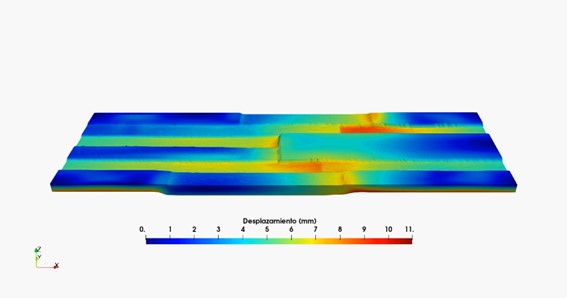
Figure 1. Finite element method (FEM) simulation: shaping of reliefs on ceramic supports using the Drugger–Prager–Cap model
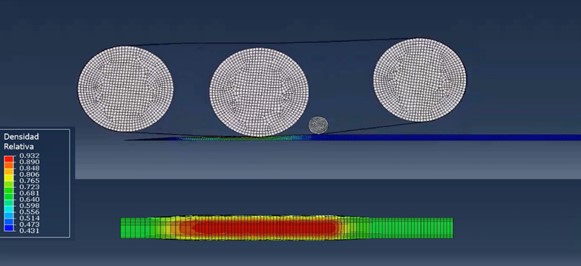
Figure 2. Finite element method (FEM) simulation: forming of ceramic sheets using the roll-forming process
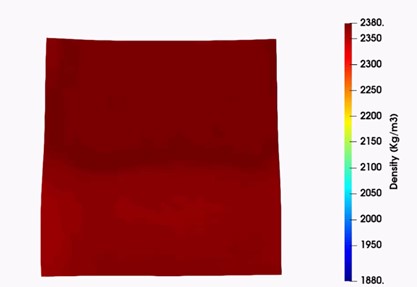
Figure 3. Simulation of deformation during sintering using the SOVS (Skorohold-Olevsky Viscous Sintering) technique
To optimise the model, the simulated results must be continuously compared with actual measurements taken on the processed product, initially in a laboratory setting and subsequently in an industrial environment. High-precision dimensional measurements, or in-depth analysis of the components using our X-ray absorption technique, amongst other tests, provide highly detailed information on the actual behaviour of the components during the process, thereby enabling us to refine the mathematical simulation model.
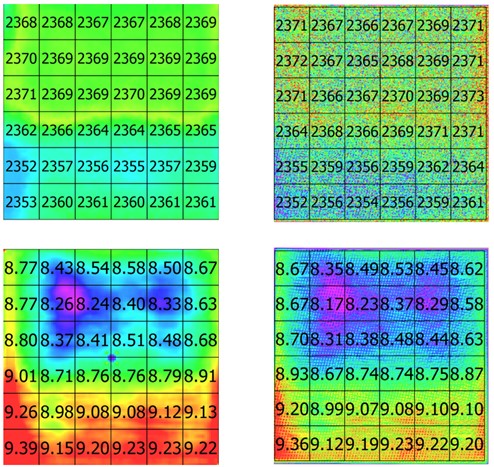
Figure 4. Simulated measurements from the mathematical model of the density distribution (top left) and thickness (bottom left) compared with actual results from parts inspected by X-ray (top and bottom right)
Conclusion: ceramic expertise and innovation for smarter manufacturing
As I have pointed out, the management and preservation of technical knowledge in the ceramics sector is essential for the continuous improvement of the production process and for ensuring high-quality products. Whilst it is very important to have experts in management or industrial automation, it is essential to value and look after professionals with experience in ceramic materials, who bring a deep understanding of the product’s properties and behaviour during the manufacturing process. The combination of practical knowledge, scientific advances and an efficient innovation process will enable factories to strive for excellence, ensuring their competitiveness and survival in the ever-changing and uncertain environment in which we typically operate.
Ramiro Bonaque
CEO of Tekinn Engineering Solutions S.L.