

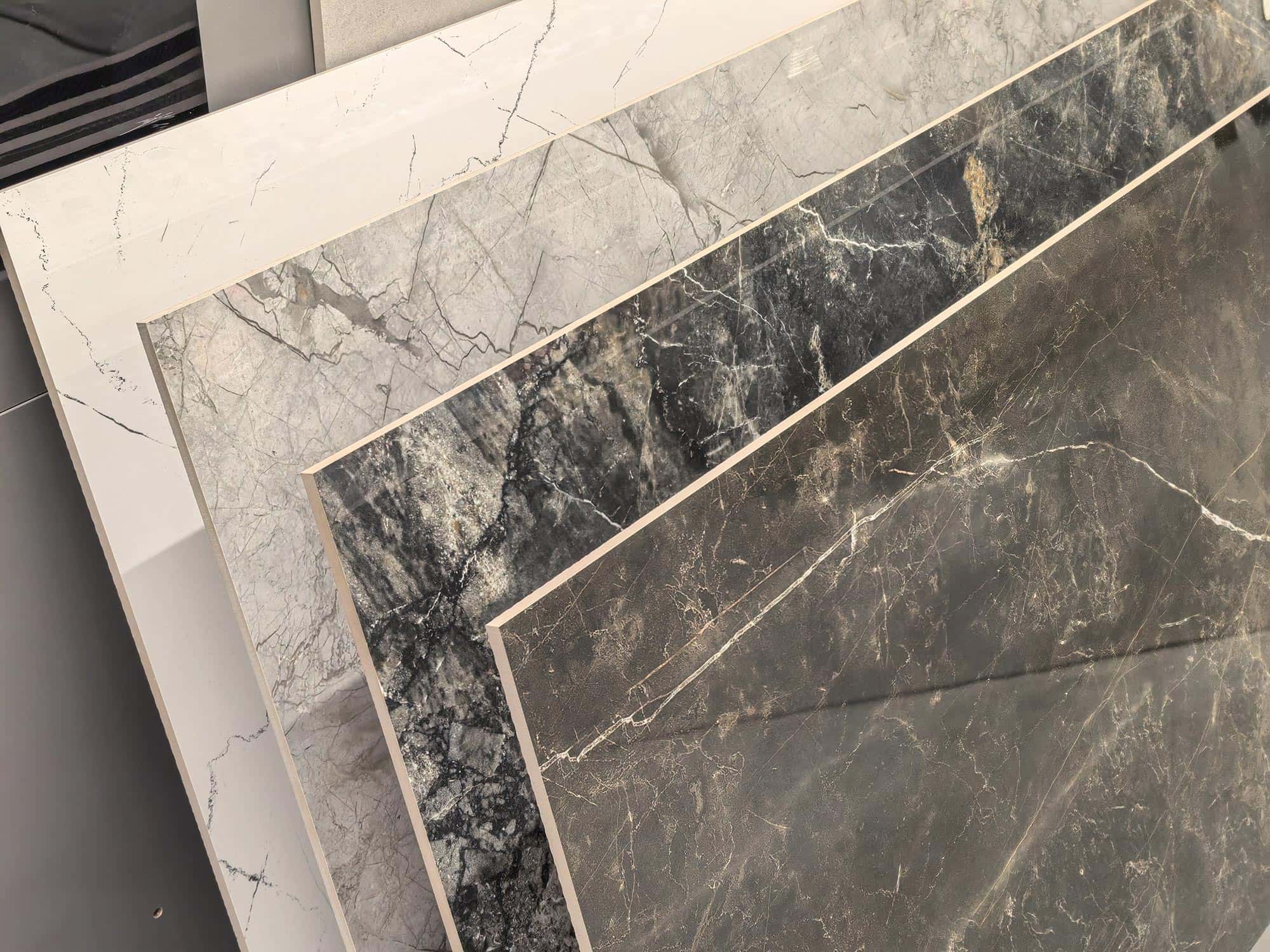
In the production of tiles of porcelain stoneware and large formats, quality control has traditionally operated reactively. When breakages spike in the grinding or cutting of ceramics, the plant's inertia usually points to misadjustments in the cutting process, diamond wheels, spindle vibrations, or cooling failures. These breakages can either be completely destructive to the piece, splitting it into two or more parts, or they can manifest as visible cracks on the edge of the piece, which is both an aesthetic defect and a possible trigger for subsequent total breakage.
However, ceramic manufacturing is a continuous process with deep interdependence. Grinding or cutting is rarely the primary source of the problem; it is almost always the trigger for a latent pathology. A variation of just 0.5 to 1% in the distribution of apparent density of a piece during pressing generates a tensional imbalance that is released unstably during abrasive machining, significantly increasing waste.
The powder cycle: the origin of variability
Tile homogeneity begins with the preparation of the spray-dried powder, where its grain size, morphology, and moisture content define the filling behavior in the mold.
- Accelerated drying: If heat transfer in the spray dryer is too fast, an impermeable outer crust forms on the granule. The trapped steam increases internal pressure and causes the particle to burst, generating hollow granules or an excess of fines.
- Flowability issues: An excess of fines alters the flowability of the mass, causing uneven sliding when feeding the press cavity.
- Insufficient resting: Spray-dried powder needs to stabilize in silos. If it reaches the press without adequate resting or with uneven moisture mixing, water (acting as a plasticizer) will not be distributed homogeneously. Drier areas or those with more fines will offer greater resistance to compaction, locally limiting the achieved density.
Defects in the body and their impact on density
| Powder anomaly | Physical mechanism | Filling behavior | Effect on bulk density |
| Accelerated drying: | Dense crust and steam accumulation. | Hollow granules and excess of fines. | Lower filling density and more friction. |
| Insufficient resting | Heterogeneous water distribution. | Agglomeration and poor powder flow. | Fluctuations in compressibility. |
| Segregation | Separation of coarse and fine particles in silos. | Uneven flow at the ends of the feeder. | Gradients between center and edges. |
The physics of uniaxial pressing and the 1% gradient
Shaping is performed by dry uniaxial pressing at pressures between 30 and 50 MPa. However, this force is not transmitted uniformly throughout the volume of the piece due to internal friction forces (between granules) and external friction forces (against the mold walls).
This lateral friction causes an exponential drop in effective pressure as depth or distance from the punch increases. As a result, the areas adjacent to the active punch reach maximum densification, while the corners and the lower center remain less compacted.
To this, two critical operational factors are added:
- Occluded air andspringback: If pressing speed is excessive, the air does not escape through the die clearances. When the punch is withdrawn, the instantaneous elastic decompression (post-pressing expansion or springback) causes the compressed air to expand, opening microscopic planes of weakness or internal laminations.
- Asymmetric filling of the mold:Wear on the feeder guides or mold blades, accumulated powder or dirt in the loading system, or poor regulation of the filling speed alter the distribution of the local powder volume in the mold. When the punch descends to a fixed level, regions with less material receive lower specific pressure, consolidating the variation of around 1% in the bulk density distribution.
The kiln as a stress amplifier
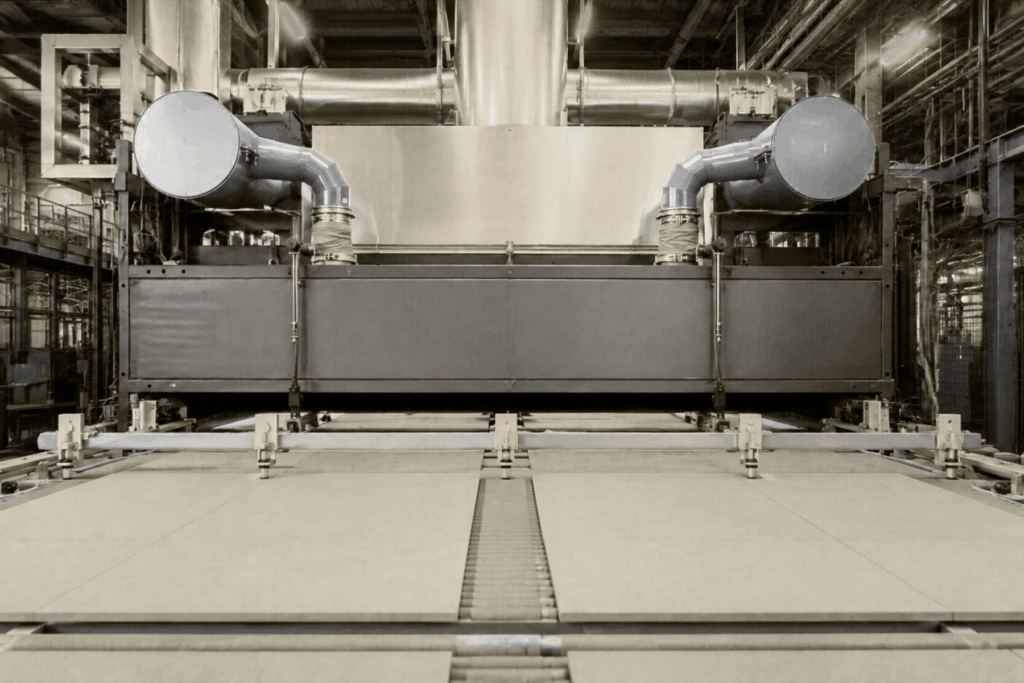
During vitrification in the roller kiln (1150°C – 1250°C), the fluxing components generate a liquid phase that fills the pores by capillarity. This process causes a linear shrinkage of between 5% and 8%.
Firing shrinkage (Sc) maintains an inverse relationship with dry bulk density (ρd) through the equation:
Sc = −k · ρd + C
Due to this physical law, regions with a 1% lower density will experience substantially greater shrinkage. Since the tile is a continuous monolithic body, adjacent areas mutually restrict their movement. Less dense areas (which try to shrink more) are subjected to intense mechanical tensile stresses, while more compact areas undergo compressive stresses.
[Variación 1% Densidad en Prensa]
▼
[Contracción Diferencial en Horno]
▼
[Asymmetric Stress Profile] ──► Tensile shift to the surface
▼
[Machining in Grinding / Cutting] ───► Violent release and crack propagation
This stress map is exacerbated during cooling. Upon dropping below the glass transition temperature (Tg), the material can no longer relax stresses through viscoelastic deformation. Furthermore, at 573°C, free quartz undergoes the α→β polymorphic transition, abruptly contracting by 1%. If density and quartz are not homogeneously distributed, the inversion occurs at the wrong time, inducing severe thermal gradients.
Under normal conditions, residual stresses keep the surfaces under protective compression and the core in tension. However, the 1% deviation in the press completely imbalances this parabolic profile, shifting maximum tensile forces toward the surface and leaving the tile in a state of unsustainable elastic vulnerability.
The tribology of ceramic grinding and cutting, the trigger
The ceramic grinding uses diamond abrasive heads to calibrate edges with surface roughness (Ra) of less than 0.1 μm. It is an extremely aggressive process that generates three primary physical interactions:
- Cutting: Diamonds penetrate the edge, overcome the toughness of the stoneware, and remove micro-chips.
- Ploughing: Abrasives plastically push the material without removing it, causing localized deformation.
- Rubbing: Direct rubbing generates massive friction and raises the local temperature at the point of contact.
If cooling is deficient or the wheel is clogged by accumulated powder, heat induces a violent thermal expansion on the edge, generating tensile stresses when abruptly cooled by water.
The ultimate reason why grinding triggers 12% of breakages is the removal of the tile's outer layer. By mechanically removing the edge, the surface layers that housed the protective compressive stresses are eliminated. A similar mechanism occurs in cutting processes due to the abrasion of the cutting tool.
To compensate for the lost symmetry, internal stresses must redistribute instantaneously. If the piece carries over the 1% gradient from the press, this redistribution is violently concentrated at the density transition interfaces (where the support is more porous and weaker). Micro-cracks introduced by the wheel or disc act as stress concentrators; the crack finds a very low-energy path and propagates catastrophically, destroying the piece.
Resistance parameters according to compaction homogeneity
| Operational Parameter | With 1% Variation in the Press | Homogeneous Compaction ( |
| Local bending strength | Reduced by up to 12% due to porosity. | High and uniform (>35 N/mm2). |
| Differential shrinkage | High, distors flatness. | Negligible, size stability. |
| Residual stresses | Asymmetric and concentrated in weak areas. | Symmetric, parabolic, and balanced. |
| Wheel / disc effect | Exceeds the tensile limit and breaks the piece. | Elastic absorption of the abrasive impact. |
| Finishing breakage rate | Escalates catastrophically up to 12%. | Minimal, controlled below 1%. |
The shift toward preventive X-ray control
Trying to mitigate these losses by modifying the grinding process (reducing line speed or changing wheels or discs) only hides the symptom, penalizing productivity. Traditional control systems at the press do not solve the problem either: they are blind to the internal volume and, being destructive, they only measure a fraction of the pieces, failing to see the potential stress distribution of the entire mass.
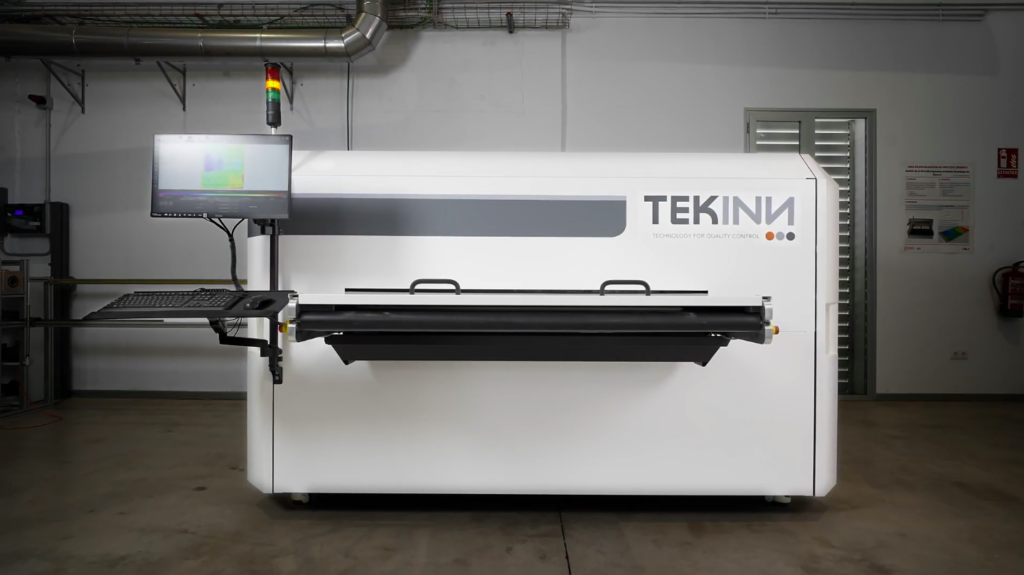
In response to this, Tekinn has developed systems based on the physics of X-ray inspection and laser telemetry. The equipment measures the attenuation of a high-energy beam as it passes through the green tile, applying physical laws to calculate the exact density of each point.
The system scans formats up to 130 x 130 cm in just 6 minutes, analyzing more than 2 million points with an accuracy of ±4 kg/m3. This generates a two-dimensional false-color map that instantly reveals poor distributions of density, thickness, or mass in the compacted piece.
Comparison of density control systems
| Technical dimension | Traditional destructive method | Digital preventive control (Tekinn) |
| Material consumption | Destructive; generates waste in green stage. | Non-destructive; |
| Response time | 30 to 60 minutes per sample. | Complete scan in less than 8 minutes. |
| Analysis resolution | Average discrete values per sample | Complete map with more than 2 million points. |
The significant economic advantage is direct: by detecting the variation quickly and with high precision at the press, pieces with breakage potential are identified before entering the kiln. This allows for rapid and efficient correction at the press to compensate for compaction differences, thereby reducing potential breakage problems during cutting or grinding.
Technical recommendations to reduce plant waste
To systematically eradicate breakages in the finishing line, technical directors should apply, among others, the following operational guidelines:
- Implement X-ray inspection in the raw stage: Continuously monitor density at the press exit to halt the propagation of pathologies before the thermal phase.
- Set strict tolerances: Configure alarms so that the local bulk density deviation within the piece does not exceed control limits, establishing corrective measures at the press if this occurs.
- Adaptive press adjustment:Use the information resulting from the X-ray inspection to immediately correct the feeder car dosing and compensate for any mold misalignment.
- Optimize grinding tribology: Ensure an abundant and precise cooling flow rate at the wheel-tile contact point. Maintain strict wheel dressing protocols at short intervals to prevent clogging and reduce mechanical vibrations.
- Stabilize spray-dried powder rheology: Monitor the holding times in the silos to keep fluctuations in the moisture content of the powder within ±0.8%, ensuring optimum flowability and eliminating the risk of significant variations in compaction.