

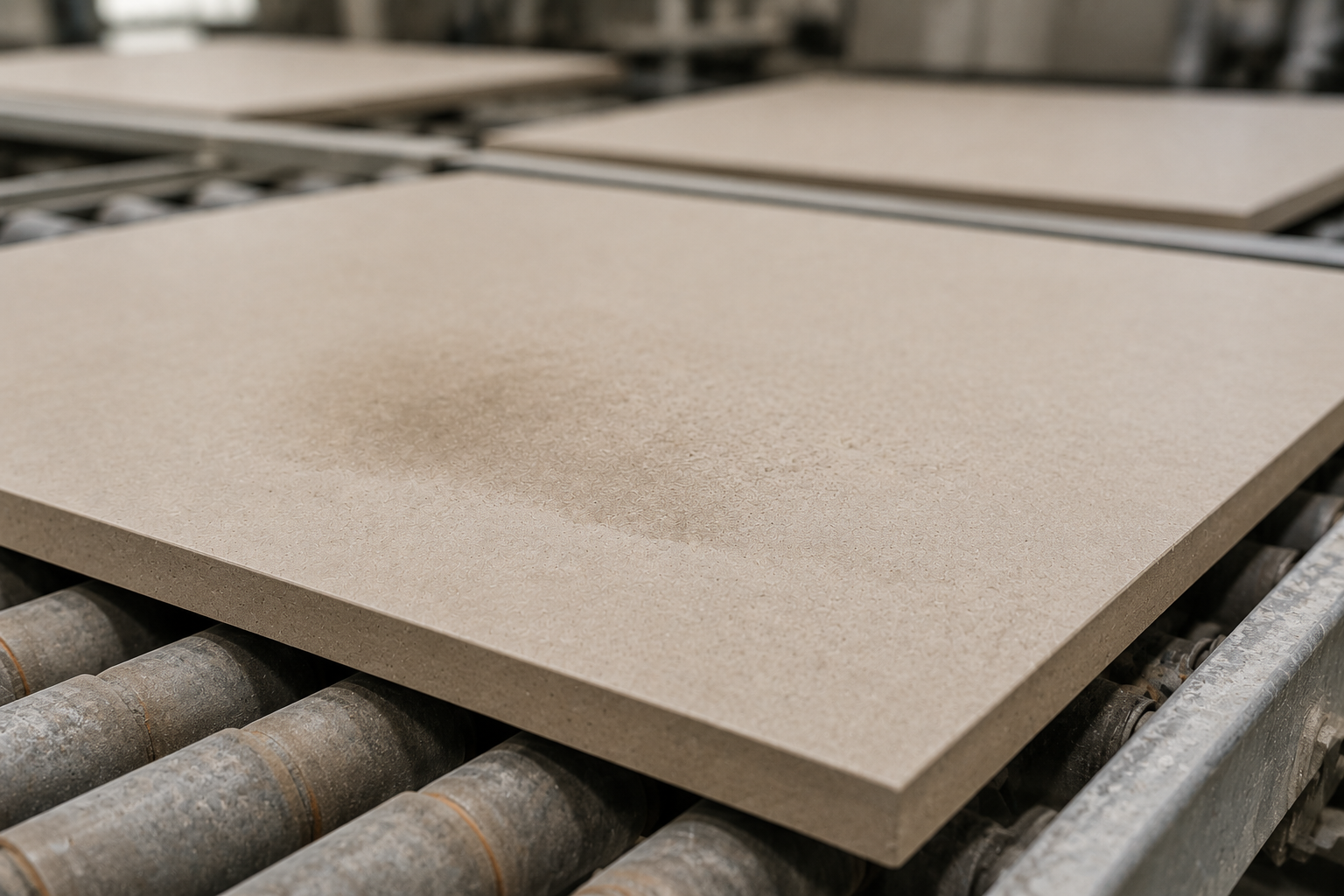
Ceramic pressing: the stage where tile quality begins
In ceramic tile manufacturing, there is one fundamental principle:
The final quality of a tile starts to be defined long before the product enters the kiln.
When a tile breaks after firing, shows dimensional deformation or develops problems during rectification, the defect usually becomes visible in the final stages of the process.
However, many of these deviations originate at an earlier stage: ceramic pressing.
Pressing is not simply about applying pressure to atomized powder to achieve a specific shape.
At this stage, the initial structure of the tile is formed:
- the distribution of material within the mould;
- the compaction of the granules;
- the evacuation of the air trapped between the granules;
- the mass distribution;
- the initial mechanical strength of the green tile.
For this reason, pressing should be understood as a critical stage in which internal conditions are established that can significantly influence the subsequent behaviour of the tile.
A correctly pressed tile will be better prepared to undergo the subsequent transformations of the process:
- drying;
- glazing;
- firing;
- grinding;
- cutting;
- sorting.
The key is not only to obtain a tile with the correct shape, but also to achieve a homogeneous internal structure.
From atomized powder to the finished tile: a continuous transformation
Before becoming a finished ceramic tile, the material passes through different states:
Atomized powder → Mould filling → Pressing and compaction → Green tile → Drying → Glazing and decoration → Firing → Finished product
Each stage modifies the properties of the material.
However, there is one key principle:
Firing transforms the tile, but it does not completely eliminate the conditions with which it enters the kiln.
A tile with internal differences in compaction may react differently during:
- water removal during drying;
- thermal transformations;
- sintering;
- cooling.
For this reason, analysing only the final defect does not always reveal the origin of the problem.
Ceramic manufacturing must be understood as a chain of transformations in which each stage affects the next.
What actually happens during ceramic pressing?
Ceramic pressing is a dry forming process in which atomized powder is introduced into a mould and subjected to high pressure to obtain a compacted tile.
During this operation, several physical phenomena occur simultaneously:
- particle rearrangement;
- granule deformation;
- reduction of internal voids;
- increase in density;
- generation of internal stresses.
Particle rearrangement during mould filling
Before pressure is applied, the atomized powder must be correctly distributed within the mould.
This stage is essential because it determines the amount of material present in each area of the tile.
The behaviour of the powder depends on factors such as:
| Variable | Influence |
| Moisture | Modifies flowability and deformability |
| Particle size distribution | Affects particle packing |
| Granule shape | Affects rearrangement |
| Particle size distribution | Influences compaction |
Irregular feeding can cause local mass differences that subsequently translate into density variations.
The preparation of atomized powder is therefore a stage directly related to the final quality of the tile. You can explore this relationship further in our article on how atomized powder moisture affects ceramic tile density.
Compaction and reduction of internal porosity
When pressure begins to be applied, the granules start to rearrange and deform.
The objective of pressing is to reduce the volume of internal voids and achieve a sufficiently compact structure.
Apparent density can be expressed using a basic relationship:
ρ = m / V
where:
- ρ represents density.
- m represents mass.
- V represents the occupied volume.
In ceramic manufacturing, increasing density is not the only objective.
The main challenge is to ensure that density is homogeneous throughout the entire tile.
Two tiles can have similar average values and yet behave differently during subsequent stages.
The green tile: the stage where the tile's future behaviour begins
The green tile is the result of pressing before firing.
Although it does not yet have the visual characteristics of the finished product, key properties have already been defined at this stage.
| Green tile property | Subsequent influence |
| Density | Affects behaviour during firing |
| Mass distribution | Affects dimensional stability |
| Mechanical strength | Allows handling without breakage |
| Internal homogeneity | Reduces deviations during the process |
A tile may appear correct externally while containing internal differences that only become apparent when the product is subjected to more demanding conditions.
This is one of the main challenges of traditional quality control: many deviations only become apparent after the tile has already absorbed a significant share of the process's added value.
Density is not just a value: it is how that density is distributed within the tile
One of the most important aspects of ceramic pressing is understanding that density should not be analysed solely as an average value.
Apparent density provides information, but an overall measurement can conceal internal differences.
For example:
| Tile | Average density | Internal distribution |
| Tile A | 2.05 g/cm³ | Homogeneous compaction |
| Tile B | 2.05 g/cm³ | Areas with different levels of compaction |
Both tiles have the same average value.
However, their behaviour during manufacturing may be different.
Why?
Because areas with different levels of compaction may experience:
- different shrinkage;
- different levels of pore removal;
- different mechanical responses.
For this reason, knowing the internal distribution of the tile provides much more complete information than a single average value.
Pressing variables that determine the internal structure of the tile
The result of ceramic pressing depends on the interaction between different process variables.
There is no single parameter that determines the final quality of a tile on its own. Product stability depends on how the characteristics of the powder, the pressing conditions and the distribution of the material within the mould interact.
The main influencing variables are:
| Process variable | Influence during pressing | Possible consequence |
| Moisture content of the atomised powder | Modifies the flowability and deformability of the granules | Compaction variations |
| Particle size distribution | Affects particle packing | Internal density differences |
| Applied pressure | Determines the degree of compaction achieved | Changes in mechanical strength |
| Pressing speed | Influences the evacuation of trapped air | Possible structural defects |
| Powder distribution in the mould | Determines the amount of material in each area | Dimensional differences |
| Condition of the mould and punches | Affects pressure transmission | Compaction gradients |
Atomized powder moisture and its influence on compaction
The moisture content of atomized powder plays a decisive role during pressing.
Moisture content influences:
- the strength of the granules;
- their ability to deform;
- the ease of rearrangement;
- the degree of compaction achieved.
A powder with unsuitable behaviour can make it difficult to achieve a homogeneous structure throughout the tile.
The relationship between moisture, compaction and density is especially important because small variations in powder preparation can lead to differences in the tile's subsequent behaviour.
To explore this relationship in greater depth, you can consult our article on how atomized powder moisture affects ceramic tile density.
Pressing pressure: more pressure does not always mean a better tile
The pressure applied during pressing is one of the most important process variables.
Increasing the pressure can increase material compaction, but the industrial objective is not to achieve the highest possible pressure.
The objective is to achieve adequate and uniform compaction.
Incorrectly adjusted pressure can cause:
- density differences within the tile;
- internal stresses;
- dimensional variations after firing.
Therefore, pressure should be analysed together with other process variables, such as powder moisture, pressing speed or the distribution of material within the mould.
How a deviation during pressing can become a problem during firing
One of the most complex aspects of the ceramic process is that the moment when a defect appears does not always coincide with the moment when it is generated.
A compaction difference created during pressing can remain invisible for several stages and only become apparent later during firing.
The reason is related to the thermal evolution of the tile.
During firing, the tile undergoes transformations such as:
- removal of residual water;
- mineralogical changes;
- densification of the ceramic body;
- shrinkage of the tile.
When different areas of the same tile have different internal structures, their evolution may not be uniform.
Differential shrinkage during firing
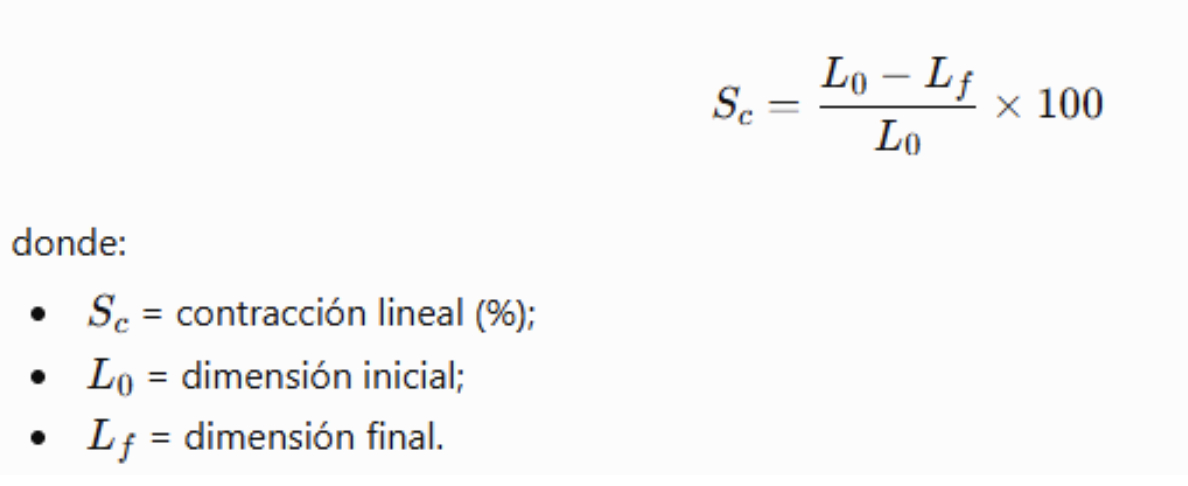
During firing, the tile undergoes a reduction in its dimensions as a result, among other phenomena, of the sintering process.
When the tile has a homogeneous structure, its dimensional evolution also tends to be more uniform. However, if there are areas with different degrees of compaction or different initial porosity, they may evolve differently during firing.
As a result, different areas of the same tile may undergo different levels of shrinkage. These differential shrinkages can generate internal stresses and contribute to the appearance of:
- deformation;
- loss of flatness;
- dimensional deviations;
- subsequent breakage.
Internal stresses: the invisible effect of a non-homogeneous structure
Internal stresses are one of the mechanisms that explain why an apparently correct tile can fail later on.
These stresses may be generated by differences in:
- density;
- porosity;
- shrinkage;
- thermal behaviour.
The tile may pass through the early stages of the process and yet have a lower capacity to withstand subsequent stresses.
For this reason, quality analysis should not be limited to the visible defect, but should also examine the internal conditions that led to its appearance.
Tekinn: turning tile data into process knowledge
Tile quality does not begin when the defect appears.
It begins when the atomized powder is transformed into a compacted tile.
Understanding what happens during pressing makes it possible to move towards more stable processes, reduce uncertainty and make decisions based on real data from the tile.
At Tekinn, we work to help ceramic manufacturers evolve from reactive control towards a preventive analysis model, providing information on the tile's internal structure before problems become visible.
Request a no-obligation demo and discover how to analyse the internal behaviour of your ceramic tiles.