

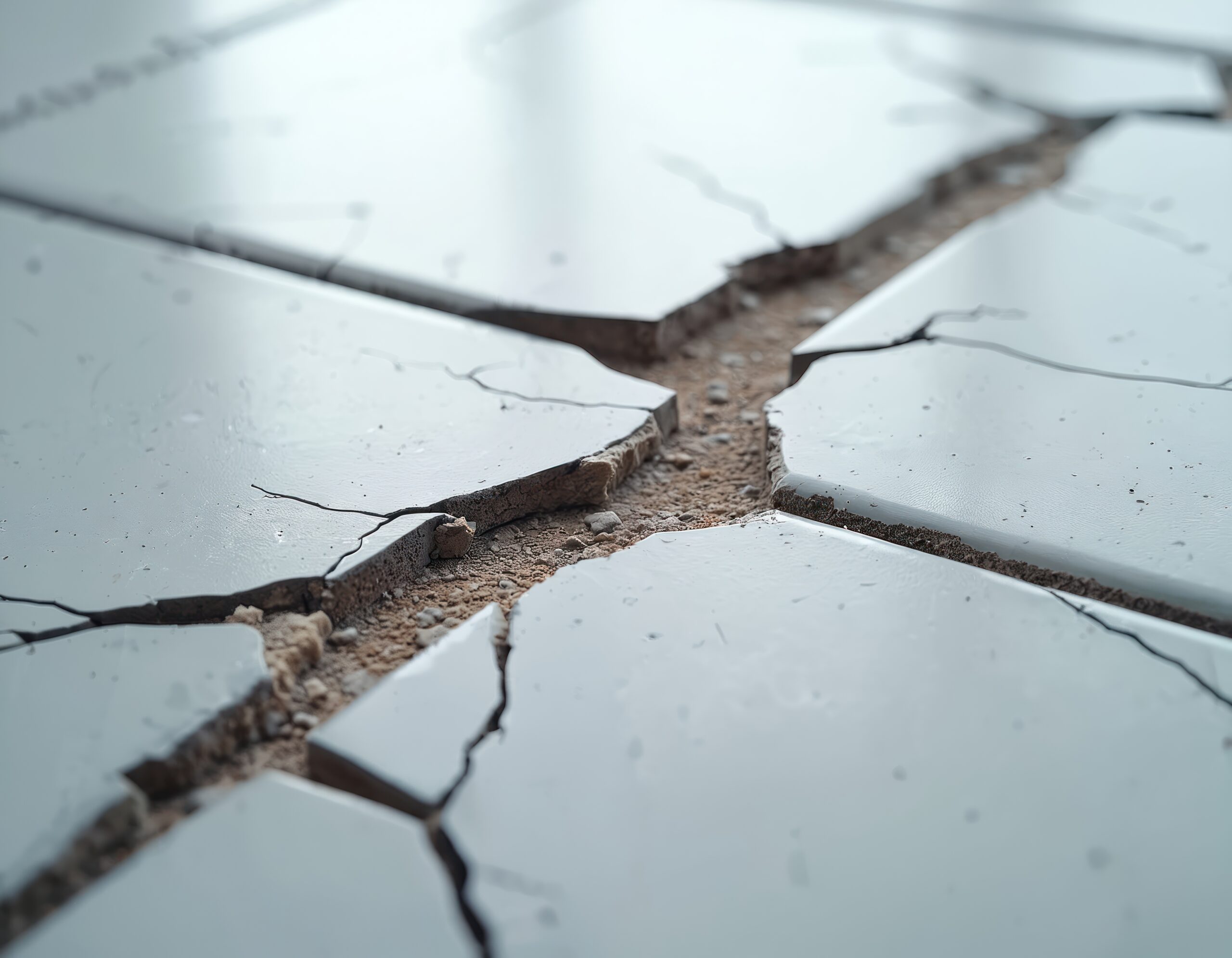
In the manufacture of ceramic tiles, not all defects originate in the press, the drying room, the kiln or the glazing line.
Some problems begin much earlier: in the raw materials themselves.
The mineralogical composition of the clays, the presence of impurities, organic matter, soluble salts, carbonates or even external contamination can affect the behaviour of the tile throughout the ceramic process.
In many cases, these defects are not visible in the pressed piece. However, they may become apparent later during drying, firing, glazing, grinding or final sorting.
Therefore, understanding the relationship between raw materials, compaction and thermal behaviour is key to anticipating defects, reducing wastage and improving process stability.
A tile may appear sound in its green state, yet contain internal conditions that will eventually lead to pinholes, craters, stains, efflorescence, black heart, warping or breakage in later stages.
The raw material defines the initial risk. But compaction can determine how that risk is distributed within the tile.
Why raw materials can cause defects in ceramics
Ceramic raw materials are not entirely homogeneous.
Although the industrial process includes stages such as selection, grinding, atomisation, pressing and firing, variations, impurities or contamination may still occur, affecting the final performance of the tile.
Some alterations are isolated and caused by specific particles within the body. Others affect large areas of the tile more generally, or even entire production batches.
From an industrial perspective, defects associated with raw materials can be grouped into four main categories:
| Type of defect | Main cause | Common examples |
| Isolated defects due to natural impurities | Mineral particles present in the raw material | Carbonates, pyrites, pyrolusite, goethite |
| Localised defects due to external contamination | Materials introduced during extraction, transport, storage or grinding | Metal particles, grease, rubber, plant debris |
| Widespread defects | Components affecting large areas of the piece | Organic matter, soluble salts, black heart, efflorescence |
| Defects due to inadequate formulation | Imbalance in the composition of the body | Excess free silica, excess carbonates, lack of dimensional stability |
LThe key point is that many of these causes do not immediately result in a visible defect. The piece may appear sound in its raw state, but may contain internal conditions that increase the risk of defects appearing at later stages.
Localised defects caused by natural impurities
Clays and other components of the ceramic body may contain mineral particles which, if not adequately removed or reduced during the preparation of the raw material, can cause localised defects.
Carbonates or calcite
Carbonates, such as calcite or dolomite, can cause problems when they appear in the form of coarse particles.
During firing, these compounds decompose and release CO₂. If the particle is large or the reaction does not proceed correctly, defects such as the following may appear:
- pinholes;
- craters;
- protrusions;
- localised cracks;
- flaking;
- deterioration of the fired piece.
Furthermore, if the calcium oxide generated does not react completely during firing, it may subsequently hydrate and cause internal expansion.
In this case, the main cause lies in the raw material and the preparation of the clay body. However, the microstructure of the piece can also influence how gases are released during firing.
Excessive or uneven compaction can hinder the escape of gases in certain areas and exacerbate the problem.
Pyrites and iron compounds
Pyrites are iron sulphides that may appear as impurities in some clays.
During firing, they can oxidise and release sulphurous gases, causing localised defects such as stains, pinholes or colour changes on the glazed surface.
Particles of metallic iron or iron oxides may also appear, resulting from contamination during extraction, transport, storage or grinding.
Depending on their size and nature, they can cause anything from small discolourations to craters or surface bumps.
In these cases, controlling raw materials, ensuring proper grinding and removing metallic contaminants are essential to reduce the risk.
Pyrolusite, goethite and other colouring minerals
Certain minerals, such as pyrolusite or goethite, can cause black spots, stains or localised discolouration on the glaze or the substrate.
Pyrolusite, which is rich in manganese, and goethite, which is associated with iron compounds, can locally alter the colour of the piece during firing.
The defect may appear superficial, but its cause lies in a specific particle incorporated into the clay body.
Coal and isolated organic residues
The presence of coal particles or organic residues can cause craters, pinholes, bubbles or dark areas if combustion during firing is not completed properly.
When these residues burn, they generate gases. If the gases cannot escape properly, they can cause surface or internal defects.
Here, there is an important relationship between raw material, firing and compaction.
The presence of organic matter is the chemical cause of the problem, but the piece’s ability to allow oxygen in and gases out also depends on its internal permeability.
Defects caused by external contamination in the ceramic body
Not all defects associated with raw materials originate from the clay itself.
During extraction, transport, storage, grinding or preparation of the body, foreign materials may be introduced that alter the behaviour of the piece.
Among the most common contaminants are:
| Contaminant | Possible effect during the process | Resulting defect |
| Metal particles | Oxidation or reaction during firing | Stains, dark spots, craters |
| Oxides caused by machinery wear | Local alteration of composition | Discolouration, lumps, surface defects |
| Fats or oils | Incomplete combustion | Pinholes, bubbles, dark areas |
| Rubber or plant debris | Burned during firing | Craters, pores, stains |
| Transport or storage residues | Localised contamination of the body | Protrusions or surface alterations |
These materials may burn, melt, oxidise or react during firing, causing protrusions, craters, stains or alterations to the glazed surface.
In these cases, prevention depends above all on good practices regarding cleaning, maintenance, raw material control, separation systems and consistency in the preparation of the body.
Mass defects: when the problem affects the entire piece
Some defects do not appear as an isolated spot, but as an internal or surface alteration affecting a significant part of the piece.
They are particularly significant because they can affect entire batches and result in significant financial losses.
Black heart: an internal defect linked to organic matter and incomplete oxidation
Black heart is one of the best-known defects associated with the presence of organic matter in the ceramic body.
It occurs when the internal oxidation of the piece is not completed properly during firing. This can result in the appearance of a dark area, a greyish core or a black line inside the body.
Black heart is not always visible from the outside. In many cases, it is only detected when the piece is cut open or when it causes associated problems, such as:
- swelling;
- deformation;
- bubbles;
- pinholes;
- structural weakening;
- cracks.
Black heart does not occur ‘suddenly’ in the kiln
Firing is the stage at which the defect becomes visible; sub-optimal firing cycle settings encourage its occurrence, but certain risk factors may arise earlier.
For the organic matter to oxidise correctly during firing, the piece requires three basic conditions:
- sufficient oxygen supply;
- adequate gas escape;
- uniform oxidation within the body.
If this balance is disrupted, the risk of poorly oxidised internal areas increases.
Here, compaction plays an important role.
Excessive compaction can reduce the internal permeability of the piece. And uneven compaction can create areas where gases find it harder to escape or where oxygen penetrates less effectively during firing.
In other words: organic matter is the source of the risk, but the internal structure of the piece can either facilitate or hinder that risk from becoming a defect.
How does compaction density relate to this?
A piece with excessive or poorly distributed bulk density may exhibit lower permeability in certain areas.
This means that, during firing, the gases generated by the combustion of organic matter may encounter greater resistance when trying to escape from inside the piece.
At the same time, oxygen may find it more difficult to penetrate evenly.
The possible result is incomplete oxidation and, therefore, a greater risk of black heart.
For this reason, in products susceptible to this defect, it is not enough to control only the formulation or the firing curve. It is also important to control how the piece is compacted and how density, thickness and mass are distributed within the pressed piece.
Soluble salts and efflorescence
Soluble salts can migrate to the surface by capillary action during drying.
When this occurs, surface deposits or stains known as efflorescence may appear. Furthermore, these salts can interfere with the adhesion of the glaze, cause surface defects or contribute to the formation of bubbles during firing.
In this case, the cause lies in the chemical composition of the raw materials or the water used in the process. Proper management of soluble salts is essential to prevent aesthetic defects and adhesion problems.
Compaction can have an indirect influence as it affects porosity and the movement of moisture within the piece.
However, the primary control at source must focus on composition, body preparation, drying and process stability.
Defects caused by errors in the body composition
In addition to impurities, an inappropriate body formulation can also lead to defects.
The ratio of clays, feldspars, sands, carbonates or other components determines the shrinkage, porosity, vitrification, mechanical strength and dimensional stability of the tile.
Excess free silica
An excess of free silica, particularly in the form of quartz, can increase the part’s susceptibility to thermal stresses.
During cooling, transformations in the quartz can generate internal stresses if the formulation is not well balanced. This can lead to breakage, cracking or problems with mechanical strength.
In this case, the defect is not directly related to compaction, but a piece with internal heterogeneities may respond less favourably to these thermal stresses.
Excess carbonates in the formulation
Carbonates can be used in certain compositions to adjust the properties of the body. However, an excess can reduce the vitrification range, increase porosity or cause dimensional problems.
An unbalanced formulation can lead to warping, variations in thickness or a lack of stability during firing.
Here it is important to distinguish between two aspects: the chemical composition of the body and the physical distribution of the pressed mass.
The former defines the material’s potential behaviour. The latter determines how each area of the piece behaves during the process.
The raw material matters, but so does compaction
Many defects associated with raw materials have a clear chemical or mineralogical cause: carbonates, pyrites, soluble salts, organic matter, free silica or contaminants.
But the final behaviour of the piece does not depend solely on what the body contains.
It also depends on how it is distributed, how it is compacted, and how it allows gases, moisture and heat to pass through during the process.
The same composition can behave differently if the part exhibits:
- areas with different bulk densities;
- variations in thickness;
- poor mass distribution;
- excessive compaction;
- insufficient compaction;
- trapped air;
- internal laminations;
- localised low permeability.
These conditions can amplify defects that originate in the raw material.
For this reason, press control does not replace raw material control. It complements it.
Chemical and mineralogical analysis helps to understand the initial risk. Compaction control helps to understand how that risk is distributed within the pressed part.
Why detecting defects in the green state helps reduce wastage
Many defects associated with raw materials only become apparent at a late stage.
Black hearts appear during firing. Efflorescence may become visible during drying. Craters, pinholes or bubbles may appear after glazing or firing. Breakages can occur during handling, grinding or cutting.
When a defect is detected at an advanced stage, the piece has already consumed raw materials, energy, glazes, production line time and kiln capacity.
Detecting risk indicators in the green state allows for earlier action:
- by adjusting compaction;
- reviewing the mold load;
- by correcting density variations;
- by controlling thickness;
- by detecting areas of low or high compaction;
- identifying repetitive patterns associated with the press or feeding system;
- preventing an entire batch from proceeding with internal risk conditions.
In large-format products, this foresight is even more important. A small internal deviation can have a greater impact due to the piece’s surface area, cumulative value and sensitivity to stresses during drying, firing, rectification or handling.
How X-ray inspection can help
X-ray inspection allows the ceramic piece to be analyzed from a volumetric perspective, not just a surface one.
In a pressed tile, information on bulk density, thickness and mass distribution can help identify internal inconsistencies that are not visible from the outside, but which may affect the tile’s subsequent behaviour.
This is particularly relevant when the risk of a defect depends on the internal structure of the substrate.
For example:
| Defect or risk | What raw data analysis can reveal |
| Black heart | Identify excessive or irregular compaction that hinders gas escape |
| Laminations | Detect areas of trapped air or internal weakness |
| Fractures | Locate areas of low compaction and reduced mechanical strength |
| Dimensional defects | Analyse irregular density distributions that may cause differential shrinkage |
| Glaze issues | Correlate porosity, surface compaction and interaction with engobes or glazes |
The advantage lies not only in detecting a defective piece.
The advantage lies in identifying early process signals before the defect progresses to more costly stages.
Controlling raw materials and controlling the process
Reducing defects associated with raw materials requires a comprehensive view of the process.
On the one hand, it is necessary to control the composition: clays, carbonates, organic matter, soluble salts, particle size distribution, contaminants and body formulation.
On the other hand, it is necessary to monitor how that paste is transformed into a pressed part: bulk density, thickness, mass, compaction and internal homogeneity.
Both checks are complementary.
A stable raw material reduces the risk of defects.
Homogeneous compaction reduces the risk of that problem escalating during the process.
Early inspection allows action to be taken before the defect becomes established.
Preventing defects means checking before they become visible
Defects associated with raw materials are not always visible at the moment they arise.
An impurity, a carbonate particle, an excess of organic matter, a soluble salt or an unbalanced formulation may remain hidden during the early stages and manifest later as pinholes, craters, stains, efflorescence, black heart, deformations or fractures.
But the behaviour of the piece does not depend solely on its composition.
It also depends on its internal structure.
That is why monitoring the bulk density, thickness and mass distribution in the pressed piece allows for a better understanding of how it will behave during drying, firing and subsequent stages.
At Tekinn, we help ceramic plants to reveal what the piece does not yet show on the outside: its interior, before the defect progresses down the line.
Because in ceramics, prevention isn’t just about controlling the raw materials.
It’s also about controlling how those raw materials are compacted, distributed and transformed into a stable, uniform and cost-effective tile.
Would you like to see how your green tiles behave before firing?Request a no-obligation technical demo.