

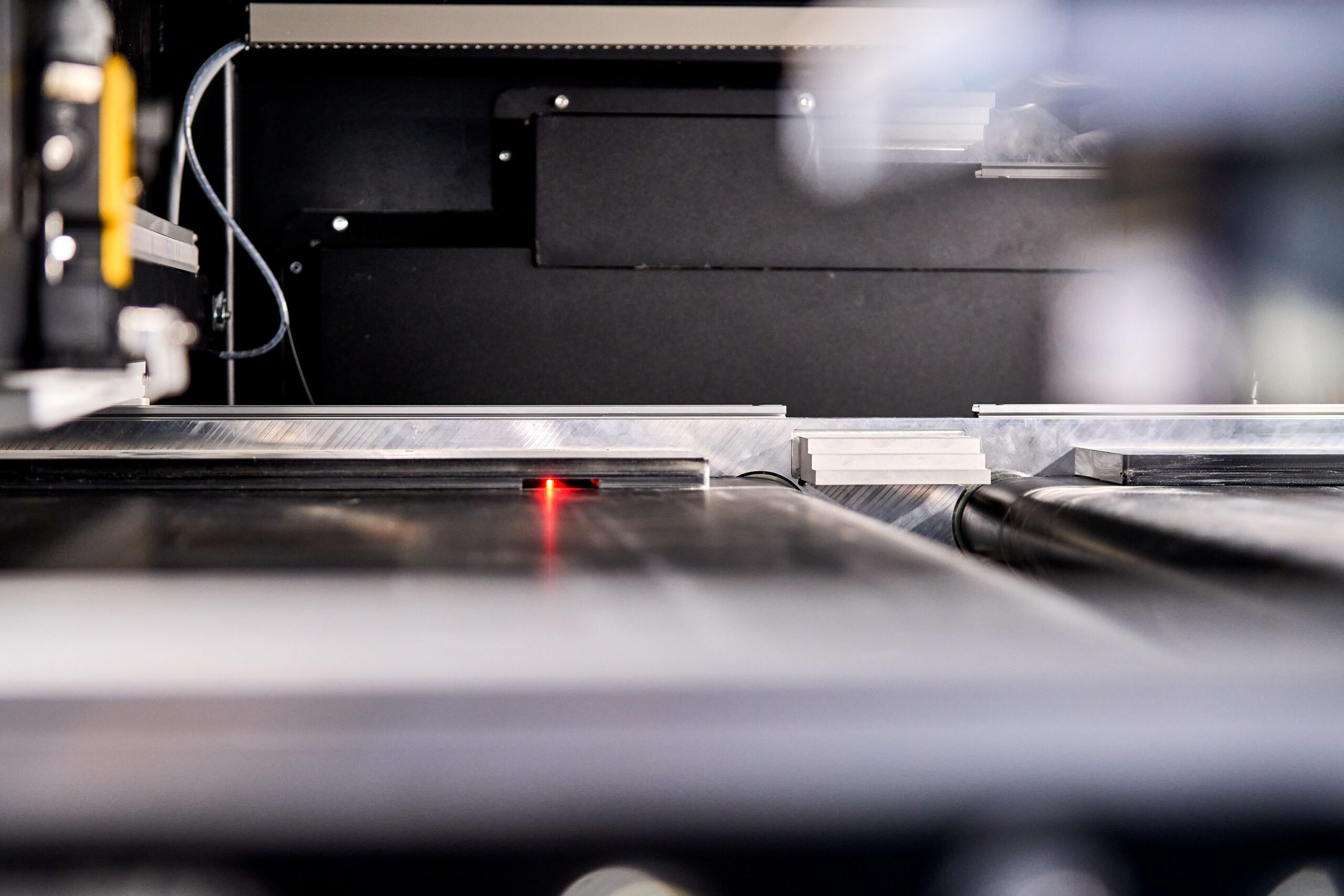
The use of X-rays in industrial settings can raise concerns.
In many cases, the obstacle is not technical. It is cultural. The term “X-rays” is quickly associated with risk, radiation, exposure or regulatory complexity. And in a ceramics plant, where every investment must be justified in terms of safety, productivity and financial return, any uncertainty can delay a decision.
But the reality is more straightforward.
TheX-rays have been used for decades in industrial inspection and quality control applications.closed X-ray systems are used to view the interior of products, packages or components without damaging them, and are used in industrial inspection, security, food, electronics and tyres.
In the ceramics industry, this technology allows the pressed piece to be analysed before firing, providing internal information on density, thickness and mass distribution. The key is to understand that radiation safety is not based on ‘trusting’ the technology, but on designing, installing, operating and maintaining it in accordance with clear technical and regulatory criteria.
Below, we explain what factors you should bear in mind, which regulations apply in Spain, and why a lack of knowledge about X-rays should not be a hindrance when the system is correctly designed, authorised and controlled.
Industrial X-rays: what they are and what they are not
Firstly, let’s clear up a common misconception: anX-ray generatoris not the same as a radioactive source.
X-rays are ionising electromagnetic radiation. They are routinely produced in X-ray tubes when electrons are accelerated by a potential difference and directed towards a target material.
This means that, in X-ray generating equipment, radiation is produced whilst the system is in operation. Put simply: the radiological risk is managed whilst the equipment is in operation. It is not a question of ‘introducing radioactivity’ into the plant or of turning the ceramic part into a radioactive material.
Organisations specialising in radiation protection (HPS)explain that X-rays used in conventional applications do not cause objects to become radioactive.
This distinction is important for technical teams, because it changes the perception of risk.
We are not talking about uncontrolled technology. We are talking about a technology whose risk can be assessed, limited and monitored through design, shielding, interlocks, signage, training and work procedures.
Why there is a fear of X-rays in the plant
Fear of X-rays usually arises for three reasons.
The first is the direct association between radiation and danger. Ionising radiation can pose a risk if not properly controlled, which is why there are specific radiation protection regulations. Royal Decree 1029/2022 sets out regulations to protect the health of workers and members of the public from the risks arising from exposure to ionising radiation.
The second reason is a lack of familiarity. Many technical managers are well versed in pressing, drying, firing, sorting or grinding, but not necessarily in the requirements of a facility with equipment that emits ionising radiation.
The third reason is the administrative perception. It is thought that incorporating X-rays means entering into a complex, uncertain or difficult-to-manage process. However, in Spain there is an established regulatory framework for this type of facility and activity.
The problem, therefore, is not the existence of regulations. It is not knowing the way forward.
Radiological safety is designed, not improvised
In an industrial setting, radiological safety must be integrated from the design stage of the facility.
An X-ray inspection system should not be viewed merely as a measuring machine. It should be understood as a system comprising:
- generator equipment;
- shielding;
- operating area;
- signage;
- safety interlocks;
- operating protocols;
- maintenance;
- staff training;
- radiological monitoring;
- technical documentation;
- and regulatory oversight.
In closed systems, the safety rationale is based on containing radiation within the equipment or inspection chamber, thereby preventing unnecessary exposure of operators and nearby personnel.
Therefore, the question should not be: “Are X-rays dangerous?”
The correct question is: “Is the system designed, installed and operated in accordance with the appropriate radiation protection requirements?”
Which regulations apply in Spain
In Spain, the radiation safety of equipment emitting ionising radiation is primarily governed by two sets of regulations.
Royal Decree 1029/2022: Health protection against ionising radiation
The Royal Decree 1029/2022 approves the Regulations on health protection against the risks arising from exposure to ionising radiation. These regulations apply, amongst other cases, to planned exposure situations involving the manufacture and operation of electrical equipment that emits ionising radiation and contains components operating at a potential difference exceeding 5 kV.
This framework sets out fundamental principles such as the justification of practices, the optimisation of radiation protection and the limitation of doses. The regulations stipulate that any new class or type of practice falling within their scope must be justified to the competent authority, and that the licence holder must apply dose constraints as a means of optimisation where appropriate.
It also sets dose limits for exposed workers and members of the public. For example, the effective dose limit for exposed workers is 20 mSv per calendar year, whilst for members of the public it is 1 mSv per calendar year.
Royal Decree 1217/2024: nuclear and radioactive facilities
The Royal Decree 1217/2024 approves the Regulations on nuclear and radioactive facilities, and other activities related to exposure to ionising radiation. These regulations replace the previous Royal Decree 1836/1999 and update the regulatory control regime, authorisations, staff accreditation, licence holders’ obligations and inspection.
The regulations establish a control regime involving authorisation, declaration, registration and inspections, as well as exemptions, for practices involving ionising radiation.
For a ceramics plant, this means that the installation of an X-ray system must be supported by technical documentation, a risk assessment, an authorisation procedure where applicable, and compliance with the requirements set by the competent authority.
CSN guidelines and instructions
The Nuclear Safety Council publishes safety guidelines to provide guidance on the application of the regulations. These include specific guidelines on technical documentation for applying for authorisation to operate X-ray facilities for industrial purposes and on radioactive installations comprising equipment for the control of industrial processes.
The CSN also states that radioactive installations require authorisations in accordance with the Regulation on Nuclear and Radioactive Installations, and that in all cases a mandatory report from the CSN is required.
Furthermore, radioactive installations must have a supervisor responsible for radiation protection aspects, holding a licence issued by the CSN. The authority may also require licence holders to have a Radiation Protection Service or to engage a Technical Radiation Protection Unit, depending on the radiological risk.
What a technical manager should consider before implementing X-ray technology
For a technical manager, the question should not be limited to whether the technology works. They must also assess how it integrates into the plant from an operational, regulatory and safety perspective.
These are the key points.
1. Type of equipment and application
Not all X-ray systems have the same use, energy, configuration or risk level. It is necessary to define whether the equipment will be used for spot inspection, process control, laboratory work, production line monitoring or recurring analysis of parts.
In ceramics, the usual objective is to obtain internal information about the pressed part to anticipate deviations in density, thickness and mass.
2. Shielding design and operating conditions
The installation must ensure that exposure remains within established limits and that work areas are correctly classified and signposted where appropriate.
In enclosed systems, shielding, physical barriers and interlocks are essential elements for preventing unauthorised access during operation.
3. Interlocks and safety systems
Interlocks prevent radiation from being generated if a door, panel or access area is not in a safe position. In enclosed systems, these elements are a fundamental part of the equipment’s safety.
4. Training and responsibilities
Staff must know what they can do, what they must not do, and how to respond to incidents. Radiation safety does not depend solely on the equipment; it also depends on its correct use.
In Spain, the CSN oversees licences, accreditations and staff supervision within the framework of regulated facilities.
5. Radiation monitoring and dosimetry
Depending on the type of facility and risk assessment, environmental measurements, periodic checks or personal dosimetry may be required. The CSN states that licence holders are responsible for radiation monitoring of the working environment and for the individual monitoring of workers.
6. Maintenance, records and traceability
Radiological safety also involves documentation. CSN Instruction IS-28 covers records relating to maintenance, training, emergency drills and dosimetry in second and third category radioactive facilities.
Common myths about X-rays in the ceramics industry
Myth 1: “The part becomes radioactive”
No. In an X-ray generation system, the part being inspected does not become a radioactive source simply because it is being analysed. X-rays pass through the material and provide information about its internal structure, but they do not leave the part “contaminated”.
Myth 2: “The equipment emits radiation all the time”
Not in the case of X-ray generator equipment. Radiation is produced when the equipment is powered up and in operation.
Myth 3: “The technology is unsafe for a factory”
The technology requires control, not improvisation. As with furnaces, presses, electrical systems, lasers or pressure equipment, safety depends on design, installation, maintenance and regulatory compliance.
Myth 4: “Regulations make the investment unviable”
Regulations add requirements, but they also provide legal and operational certainty. The aim is not to block the technology, but to ensure it is used safely for workers, the plant and the environment.
Myth 5: “It’s only useful for laboratories”
X-ray inspection can be integrated into industrial quality control environments. Closed X-ray systems are used in industrial quality applications, including the inspection of food, circuits and tyres.
Radiological safety and cost-effectiveness: two compatible concepts
In a ceramics plant, every investment must justify its impact.
X-rays should not be considered solely from a technological perspective. They must be assessed for their ability to provide data before a defect progresses down the production line.
By the time a piece with internal irregularities reaches the kiln, the trimming stage or sorting, the costs have already accumulated: raw materials, energy, glaze, line time, handling and production capacity.
X-ray inspection allows for a change in approach.
Instead of waiting for the defect to become visible at the end of the process, it allows internal signals in the pressed piece to be observed. This helps the technical team to detect deviations related to density, thickness and mass distribution before firing.
From a safety perspective, the key is that this inspection capability is integrated into a properly designed and regulated system.
From a production perspective, the key is that the data enables action to be taken earlier.
How to approach the decision to incorporate X-ray internally
To reduce internal resistance, it is advisable to consider the investment at three levels.
Technical level
What information does the system provide that we do not currently have?
In the case of Tekinn, the value lies in visualising the internal distribution of density, thickness and mass within the pressed part.
Operational level
How does the system integrate into the production line or the quality control process?
The answer must take into account location, workflow, personnel involved, inspection times, maintenance and data usage.
Regulatory level
What requirements regarding authorisation, documentation, training, monitoring and radiation protection apply?
Here, it is advisable to work from the outset with radiation protection specialists and with the necessary technical documentation to avoid subsequent delays.
Frequently asked questions about radiation safety in the ceramics industry
Is X-ray inspection safe?
It can be safe when the system is correctly designed, shielded, authorised, maintained and operated in accordance with radiation protection procedures. Safety depends not only on the technology, but on the entire control system.
Is the tile contaminated after inspection?
No. Inspection using an X-ray generator does not make the item radioactive. Radiation is produced whilst the equipment is in operation and does not leave the item as a source of radiation.
Is authorisation required to install industrial X-ray equipment?
In Spain, equipment that emits ionising radiation is subject to a regulatory framework. The specific authorisation or procedure required will depend on the type of equipment, its use, installation and operating characteristics. The CSN states that radioactive installations are authorised in accordance with the Regulation on Nuclear and Radioactive Installations.
Who should operate the equipment?
Personnel must be trained and operate the equipment in accordance with defined procedures. Depending on the type of installation, there may be requirements for licences, supervision or support from technical radiation protection units.
What does X-ray inspection offer compared to other inspection methods?
It provides internal information. In ceramics, this allows for the analysis of variables that are not always visible on the surface, such as variations in density, thickness or mass distribution within the pressed part.
Safety, control and knowledge: the true approach
Fear of X-rays often stems from a flawed perception: associating radiation with danger without analysing the technical context.
But in industry, the question is not whether there is a risk. The question is whether that risk is identified, controlled and justified by the value the technology provides.
Furnaces, presses, power lines, cutting systems and high-pressure equipment also involve risks. The difference lies in how they are managed.
The same applies to X-rays.
When a system is properly designed, shielded, authorised, maintained and operated, X-ray inspection can become an advanced quality control tool for the ceramics industry.
It allows us to see what the piece does not yet reveal on the outside. It enables us to anticipate deviations before the piece enters the kiln. And it allows us to make technical decisions based on data, not just on visible symptoms at the end of the line.
At Tekinn, we help ceramic plants move from late-stage correction to preventive control at source, integrating X-ray inspection technology to analyse density, thickness and mass distribution in pressed parts.
Radiological safety should not be a barrier to innovation.
It must be part of the project from day one.
Would you like to find out how X-ray inspection can be integrated into your ceramic process?Request a no-obligation technical demo.