

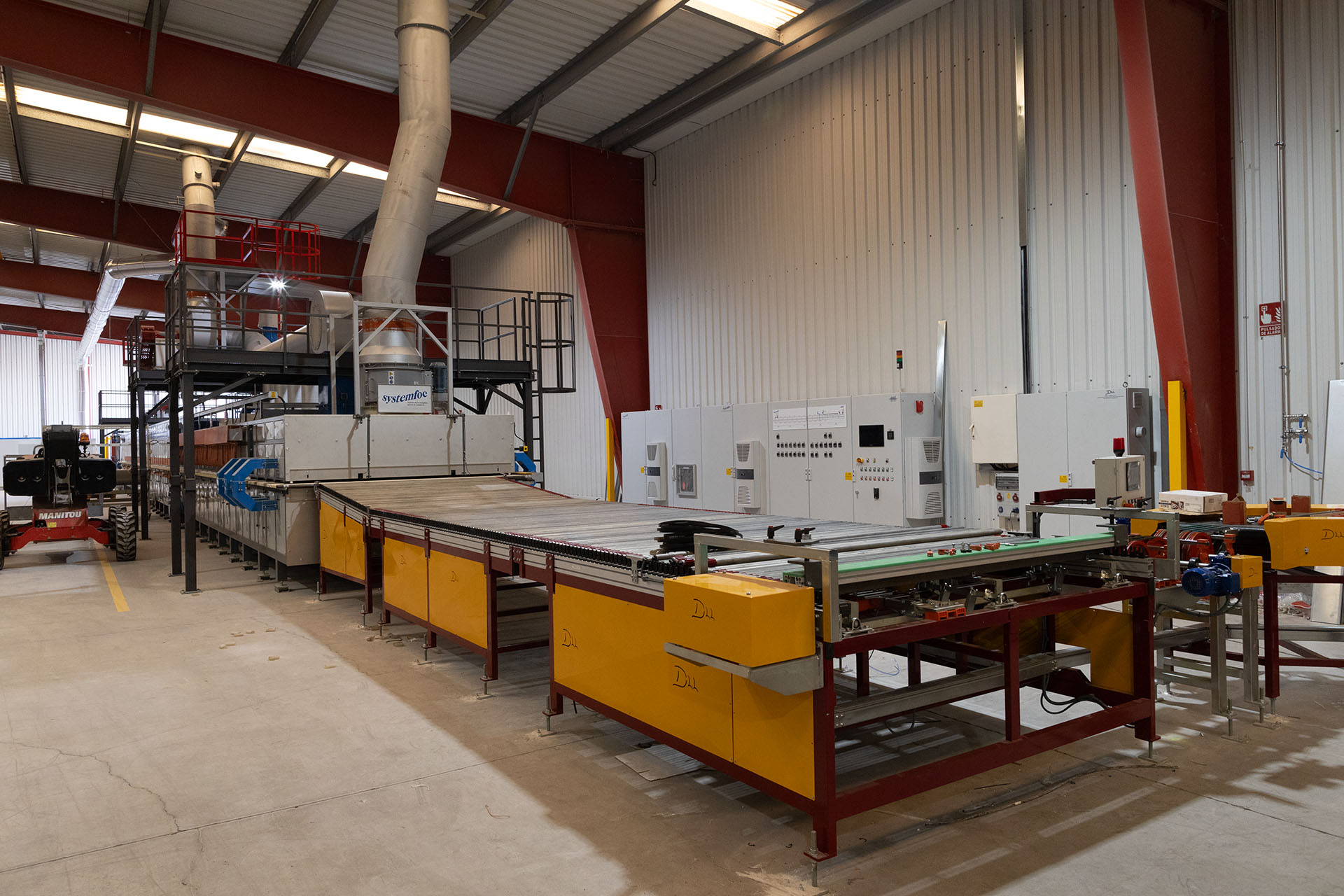
The electrification of firing is no longer a future hypothesis for the ceramic industry. It is a reality that is progressing from experimentation towards industrial implementation.
But changing kilns is not simply a matter of replacing gas with electricity.
It also means reviewing how the material responds to a new heat distribution, a different atmosphere and a sintering window that may not behave in the same way as the one known until now.
The technical question is not only:
“Can my product be fired in an electric kiln?”
The relevant question is:
“Which internal defects in my tile may become more visible when the firing conditions change?”
A tile that enters the kiln with an uneven density distribution does not cease to have that problem when the process is electrified.
What may change is how that defect develops.
Are you assessing how your product may respond to a new firing curve or an electrified kiln?
Before validating only the final result, it is important to understand the condition of the tile as it enters the kiln.
Discover how Tekinn analyses the distribution of density, thickness and mass in the unfired tile to identify heterogeneities before firing.
Changing the energy source changes the thermal system
A gas kiln and an electric kiln do not transfer heat in exactly the same way.
Changing the energy source also changes the balance between radiation, convection and conduction. It also changes the composition of the atmosphere surrounding the tile during firing.
In a natural gas-fired kiln, the combustion products introduce water vapour and CO₂ into the kiln atmosphere. In an electric system, the atmosphere depends mainly on the process air, ventilation and the gases released by the material itself.
This does not mean that electric firing is less stable.
It means that the known behaviour of a formulation, firing curve or glaze should not be taken for granted without validation.
Each ceramic body responds differently to the change.
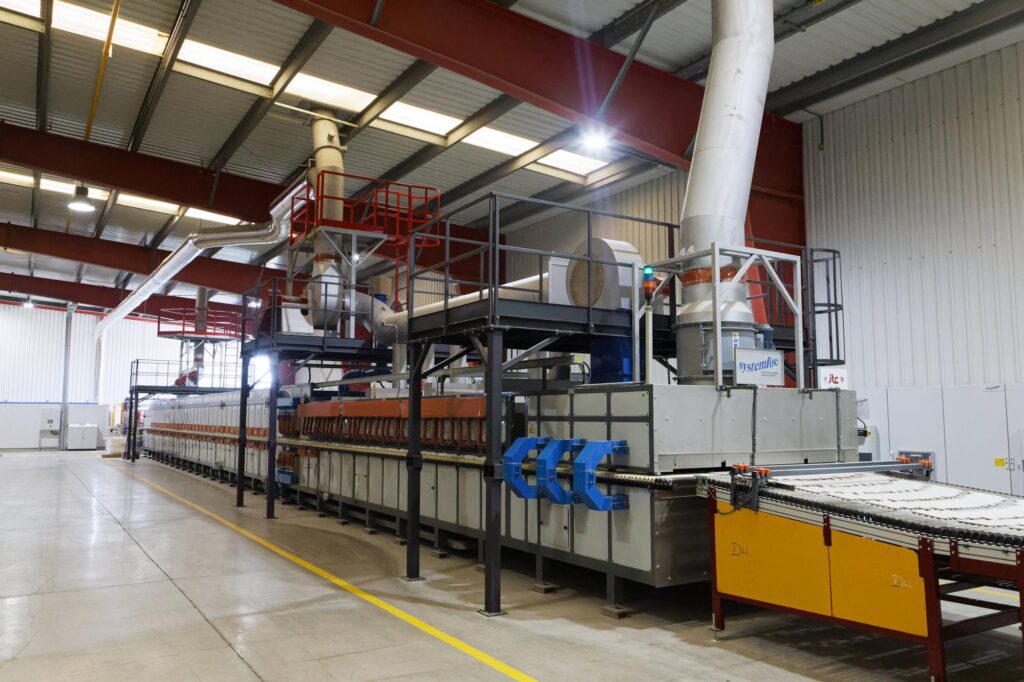
The atmosphere also plays a role in sintering
In porcelain stoneware, the kiln atmosphere can modify the viscosity of the liquid phase and, with it, the sintering rate.
A study presented at Qualicer found that, when the water vapour content in the firing atmosphere was increased, the temperature required to achieve 0.5% water absorption in porcelain stoneware fell from 1,183°C to 1,170°C under the conditions tested.
This finding does not mean that all electric kilns should operate at a higher or lower temperature.
It means something more important:
the atmosphere is a process parameter.
Therefore, when the firing system changes, simply replicating the maximum temperature of the previous kiln is not enough.
The following must be validated again:
- The heating curve.
- The soaking time.
- The kiln atmosphere.
- The evolution of the liquid phase.
- Firing shrinkage.
- Final porosity.
- Glaze behaviour.
The kiln does not correct a heterogeneous tile
Electrification can optimise energy efficiency and reduce direct CO₂ emissions. However, it does not eliminate the internal variations that the tile carries over from the press.
If a tile enters the kiln with areas of different apparent density, those areas will not react in the same way during sintering.
Less compacted regions may undergo different thermal evolution and shrinkage from denser areas. This difference generates internal stresses, deformation, calibre variation or lower strength in subsequent stages.
In other words:
The kiln does not necessarily create the defect.
It may amplify a difference that already existed in the unfired tile.
This risk is particularly relevant in products with narrower technical margins:
- Thin slabs.
- Large-format tiles.
- Thicker products.
- Rectified tiles.
- Products with sensitive glaze systems.
- Collections with demanding dimensional tolerances.
When the cycle changes, process tolerance changes
A formulation may appear to be stable in a gas kiln because the plant is familiar with how the body responds to that combination of temperature, atmosphere and line speed.
When the thermal conditions change, some previously tolerated internal deviations may no longer be acceptable.
Not because the electric kiln is inherently more aggressive.
But because the context in which the body and glaze densify changes.
A localised difference in density, thickness or mass may result in:
- Differential shrinkage.
- Warpage and flatness deviations.
- Calibre variation.
- Residual stresses.
- Microcracks.
- Breakage during rectification or cutting.
- Changes in absorption and glaze development.
The objective is not to increase the number of inspections.
It is to improve the quality of the information used to make decisions.
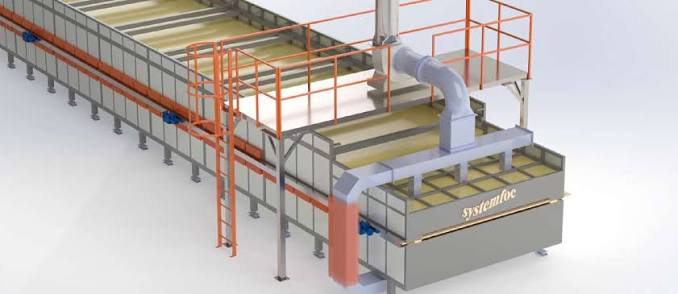
Electrification requires a better understanding of the tile before it enters the kiln
When validating a new firing technology, measuring only the final result is not enough.
If the defect appears after firing, the technical team needs to know whether it originated in the thermal curve or whether the tile already had an uneven internal distribution before firing.
This is why unfired tile inspection becomes more important.
Analysing the distribution of density, thickness and mass in the pressed tile makes it possible to identify heterogeneities before they enter a thermal stage where the accumulated cost is higher.
Tekinn uses X-ray inspection to make this internal information visible in the green tile.
It does not replace kiln validation.
It complements it.
A sound electrification strategy must therefore answer two questions:
- How does the thermal behaviour of our formulation change?
- What internal variations are we introducing into the tile before firing?
At Tekinn, we carry out demonstrations using real tiles at our facilities, accompanied by a technical report and specialist advice.
Request a demo with no obligation and discover what information X-ray analysis can bring to your process.
Five checks before validating electric firing
Before transferring a product reference to a new kiln or thermal curve, it is advisable to review:
- Unfired density homogeneity
Checking the average value is not enough. It is necessary to understand how density is distributed throughout the tile. - Thickness and mass distribution
A geometric variation can become a difference in thermal response. - Actual firing curve
Maximum temperature, heating rate, soaking time and cooling must be validated on the actual product. - Kiln atmosphere and ventilation
Changing the energy source alters the chemical conditions surrounding the tile. - Final finishing performance
Flatness, calibre, absorption, mechanical strength and response during rectification must form part of the validation.
Electrification is also about prevention
The energy transition should not mean accepting greater uncertainty in quality.
It should be an opportunity to gain a better understanding of the process.
Kiln electrification opens a new stage for the ceramic industry. But its success does not depend solely on reaching the right temperature.
It depends on understanding the condition of the tile when it reaches that temperature.
The more demanding the product, the less room there is to work with invisible defects.
Before redefining the kiln, it is important to make the tile transparent.
Are you validating a formulation or format for electric firing?
At Tekinn, we analyse the density, thickness and mass distribution of the pressed tile to provide technical information before the defect reaches the kiln.
Main sources used in the text for further information:
- Institute of Ceramic Technology – ITC: https://www.itc.uji.es/
- Qualicer.org: https://www.qualicer.org/programa/2024/ING/Ponencias/C/27%20pon%20ing.pdf
- ScienceDirect: https://www.sciencedirect.com/science/article/pii/S1364032122000119
- SystemFoc: https://systemfoc.com/