

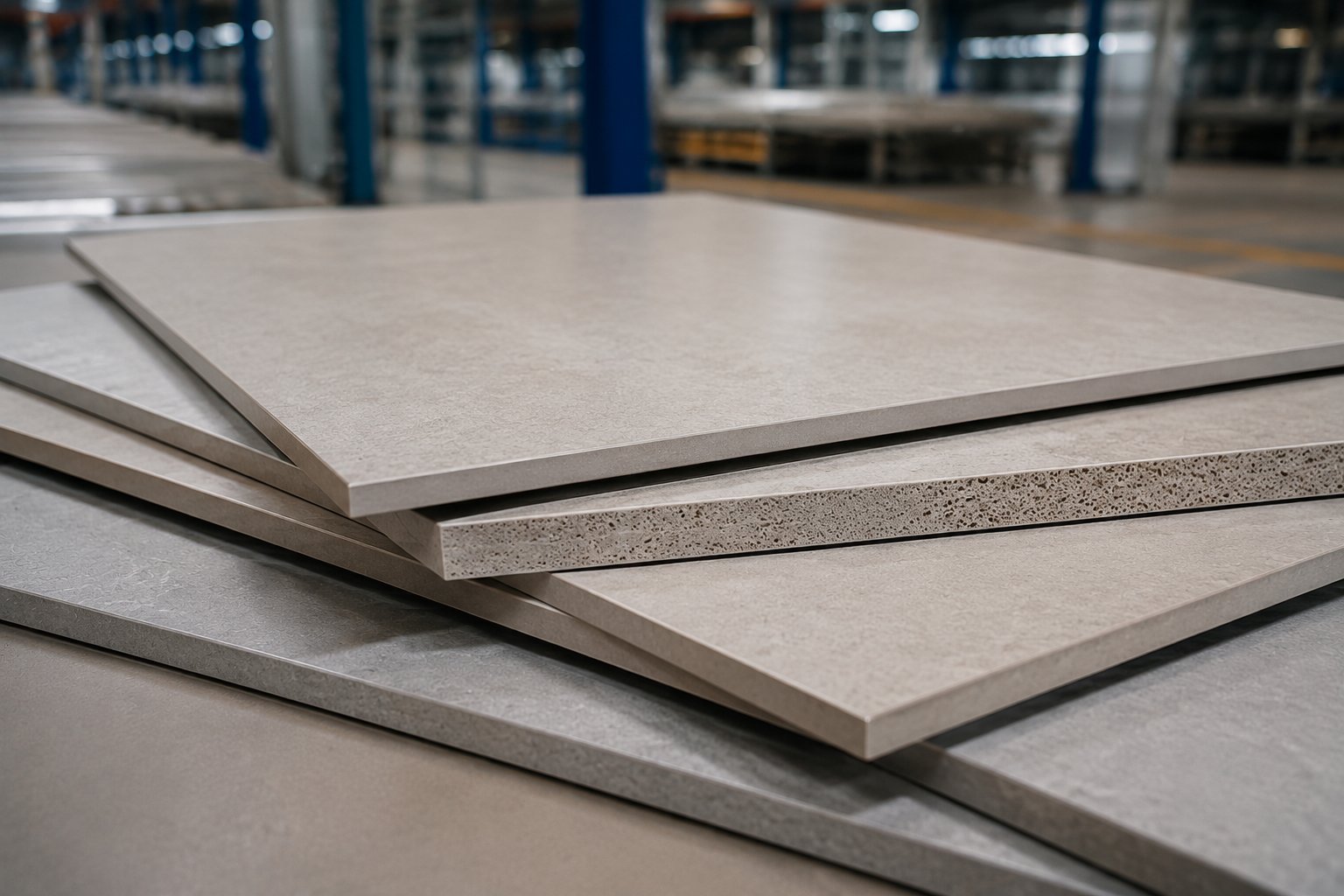
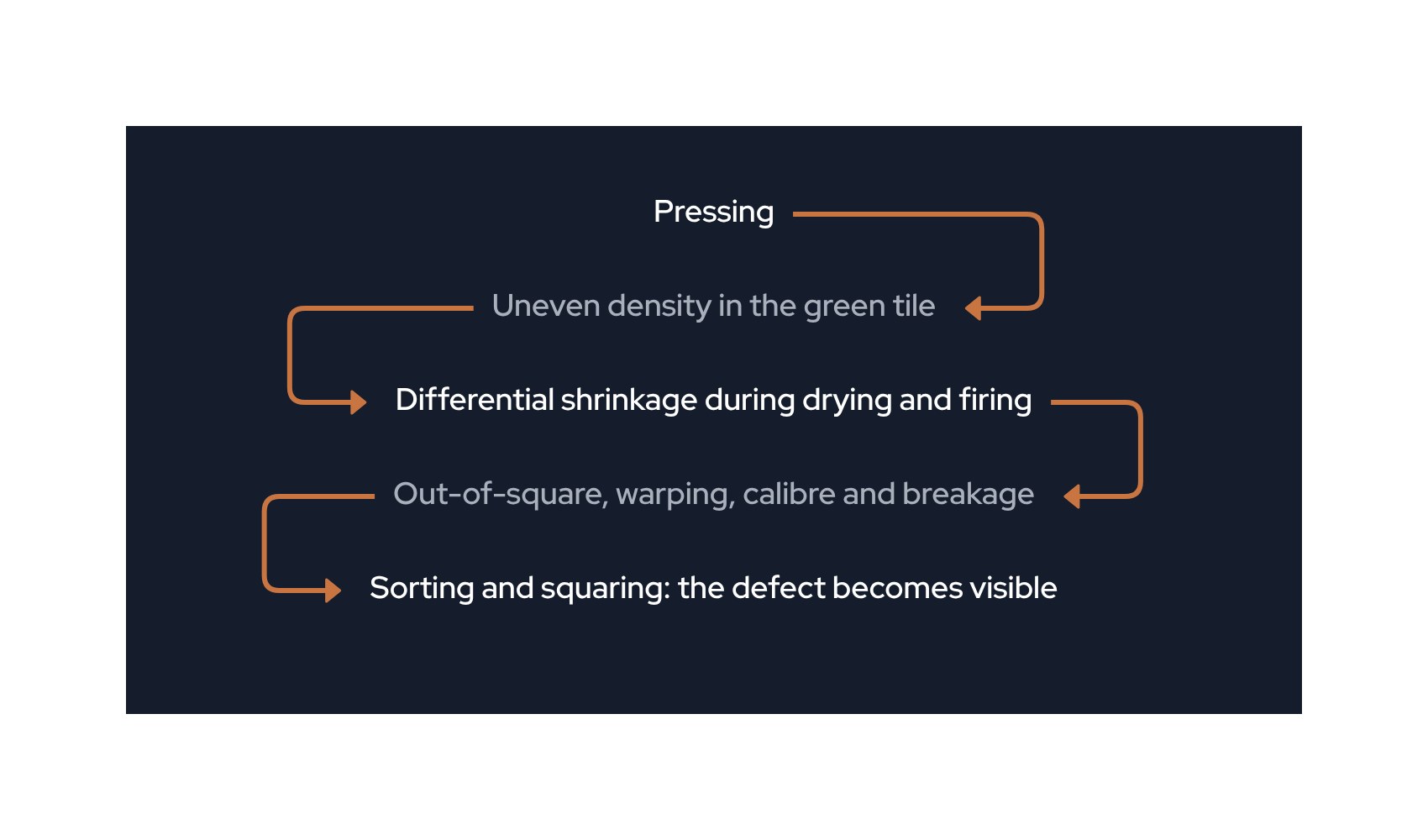
Uneven bulk density in the pressed tile lies behind out-of-square pieces, warping, cracks, breakage during cutting, size (calibre) differences and shade variations. The problem originates in the press, but it is almost never seen there: it shows up in the dryer, in the kiln, at sorting or during squaring, when the tile has already consumed energy, glaze and line time.
Two types of heterogeneity: within the tile and between tiles
Not all density differences are the same, and telling them apart is the first step in the diagnosis. The ITC study published in the Bulletin of the Spanish Ceramic and Glass Society in 2010 already identified both situations as a cause of major defects.
- Within the same tile. Some areas of the tile are more compacted than others. During drying and firing, each area shrinks differently and the tile builds up stresses or becomes deformed.
- Between tiles from the same pressing cycle or from different mould cavities. Each tile may be homogeneous in itself, but its average density does not match that of its neighbours. The typical result is batches with tiles of different size or thickness.
A one-off measurement of average density, taken on a few test specimens, may fail to detect either situation. That is why the useful question is not only what the density is, but how it is distributed.
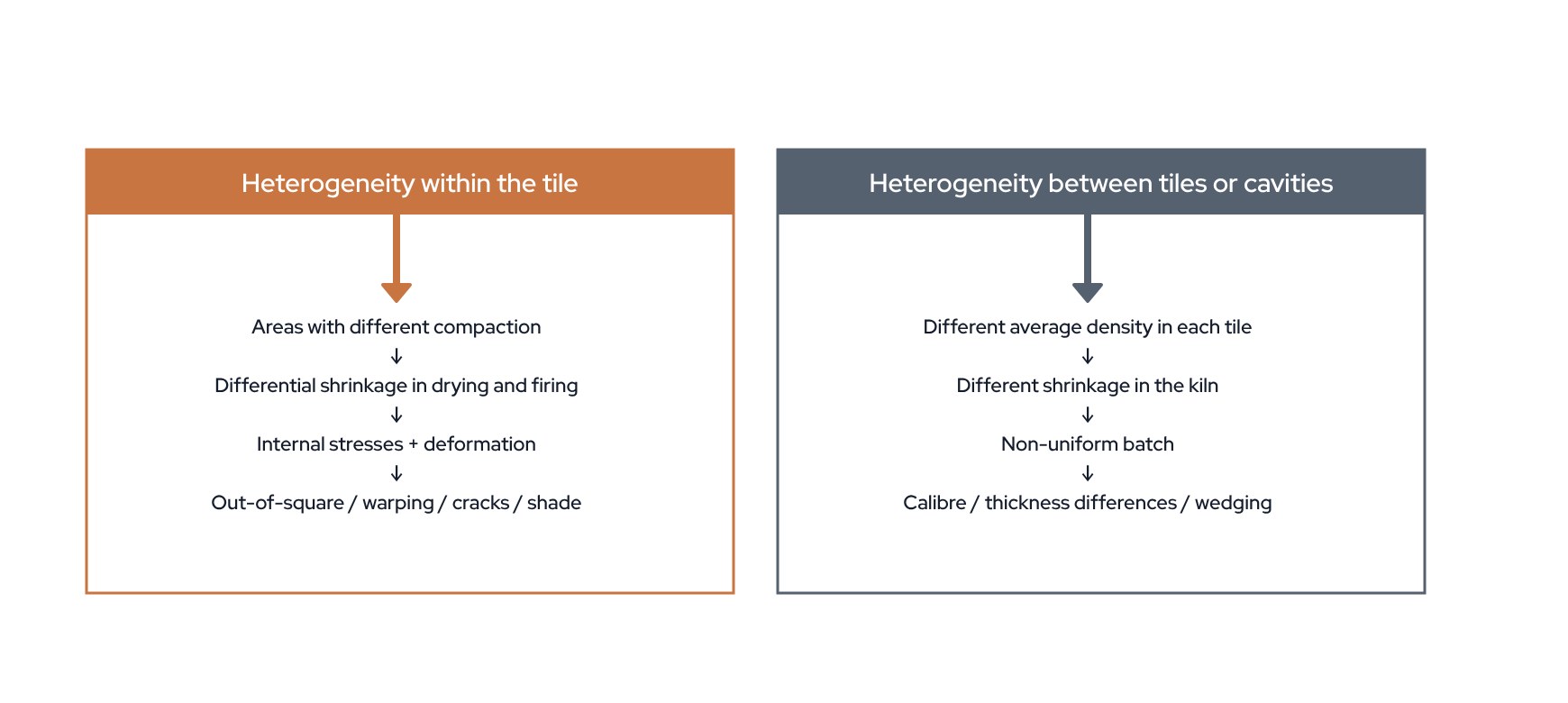
Defects when density varies within the tile
When a tile has areas with different compaction, each area responds differently to drying, firing and mechanical stresses. These are the most common defects.
Out-of-square tiles
The tile comes out of the kiln with sides of different lengths or with angles that are not 90°. According to the ITC defect analysis, this is caused by an irregular bulk density distribution that leads to different linear shrinkage between areas of the tile. It is more pronounced in products with higher firing shrinkage, such as floor tiles: the more the tile shrinks, the more uniform its density needs to be.
Warping: concave and convex curvature
When the centre and the edges of the tile have different compaction, they shrink differently during firing and the tile loses flatness. The most common forms are concave or convex curvature, known in the Spanish industry as “luneta” and “bombatura”. The ITC links them to poor filling of the mould cavity, inconsistent press powder or imperfect flatness of the punches, and notes that uneven compaction becomes more pronounced as thickness decreases. This is a relevant point at a time when large formats and thin slabs are growing.
Cracks during drying and handling
Less compacted areas have lower green mechanical strength. The tile may leave the press apparently sound and then crack when it is extracted from the mould, during internal transport or in the dryer, where differential shrinkage between areas adds stresses. Some cracks remain hidden and only show up in later stages.
Breakage during cutting and squaring
A weak area or one with internal stresses may withstand the whole process and break at the last step, when the tile has the most added value. We cover this in breakage during cutting and squaring.
Differences in glaze absorption and shade
Areas with lower density have higher porosity and absorb differently. The result can be shadows, gloss differences or shade variations within the same tile, especially visible in continuous finishes and large formats.
Defects when density varies between tiles or mould cavities
If the heterogeneity is between tiles, the problem is not usually visible in a single tile, but when comparing the tiles in the same batch.
Size (calibre) differences
Tiles with different average density shrink differently in the kiln and come out with different sizes. The result is a wider spread of calibres, more complex sorting and more problems in storage and installation. The ITC defect analysis attributes calibre differences to three possible causes: firing temperature, changes in composition and variations in compaction. That is why it is worth knowing which of the three is at play before making corrections.
Wedging and thickness differences
Wedging is a difference in thickness between two opposite sides of the tile. Its most frequent cause is non-parallel pressing between punch and die, although it can also be due to irregular mould filling. A related case is presses that produce tiles of different thicknesses, with effects on drying, glazing, firing and sorting.
When the feeder carriage tends to fill the front or rear part of the mould cavity more, the correction involves the carriage travel speed and the timing of the punch descent.
Does the defect originate in the press? Diagnostic table
Several of these defects can have more than one origin. Based on the ITC defect analysis, the table summarises where each one is detected, how it relates to pressing and which other causes should be ruled out.
| Defect | Where it is detected | Origin in the press | Other origins to rule out |
| Out-of-square | Kiln exit, sorting | Irregular density distribution due to improper mould filling | Tiles placed too close to the kiln walls |
| Warping (concave, convex) | Kiln exit | Poor filling of the mould cavity, inconsistent press powder, non-flat punches | Faster drying on one face than on the other |
| Edge cracks | Extraction, transport, dryer | Insufficient or irregular compaction, poor extraction | Excessively plastic body, abnormal drying curve |
| Breakage during cutting or squaring | Cutting, squaring | Areas of low compaction or with internal stresses | Cutting and squaring parameters |
| Size (calibre) differences | Sorting | Variations in compaction between tiles | Firing temperature, changes in composition |
| Wedging, thickness differences | Press, dimensional control | Non-parallel pressing between punch and die, irregular filling | — |
| Shade or absorption differences | Glazing, kiln exit | Areas of different porosity due to different compaction | Glaze thickness, firing temperature |
If the defect always repeats in the same press, the same mould cavity or the same area of the tile, it is a clear sign that the search should start in the forming stage.
Common causes in the press
When the diagnosis points to forming, these are the variables that the ITC defect analysis links to irregular compaction.
- Mould filling. Uniform and consistent filling of the mould is one of the most critical stages of pressing. Partial blockage of the feeder carriage leaves an area of lower density; poor adjustment of the fill loads one part of the mould cavity more than another.
- Powder flowability and density. A powder with good flowability allows the mould to be filled at high speed without losing uniformity. If its bulk density is too low, the amount of air to be expelled increases, as does the ratio between the fill height and the height of the pressed tile.
- Spray-dried powder moisture. It determines how the material compacts and how it behaves when it leaves the mould. We explain this in how spray-dried powder moisture affects density.
- Tooling condition. Punches that are not flat, mould wear or insufficient taper of the mould cavity affect the compaction distribution and the extraction of the tile.
If you want to see the whole process, from powder to green tile, we cover it in ceramic pressing.
Why a one-off measurement is not enough: the density map of the green tile
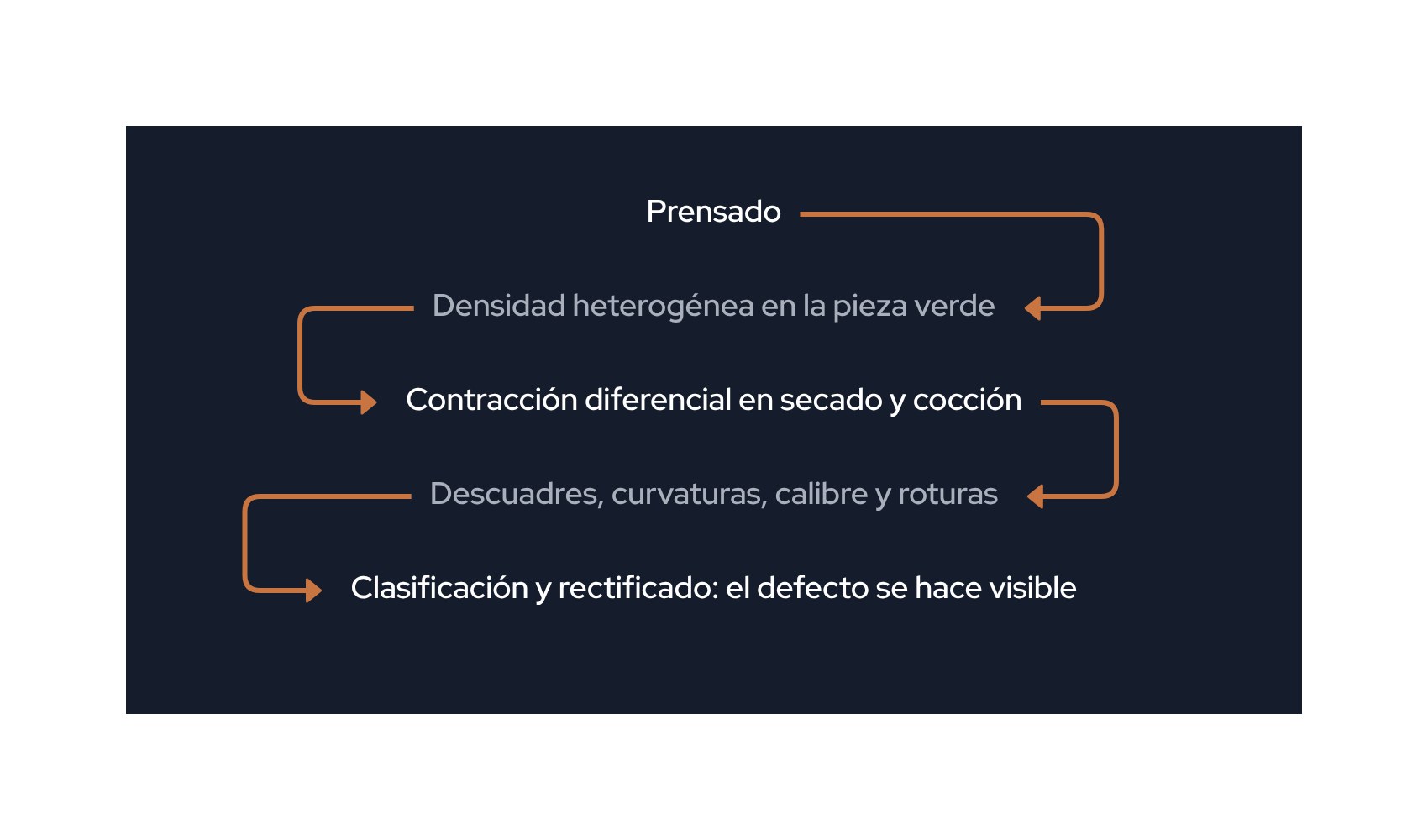
All these defects share one feature: they are generated in the green tile and become visible later. When they appear at sorting or during squaring, the tile has already consumed kiln energy, glaze and line time, and the information needed to correct the press arrives too late.
Traditional methods measure density on specific test specimens and destructively. They are useful for monitoring trends, but they do not show how density is distributed across the whole surface of the tile or whether it changes between mould cavities.
X-ray inspection of the pressed tile makes it possible to obtain density, thickness and mass maps before firing and without destroying the tile. With this information you can see where the heterogeneity lies, whether it repeats in a specific press or mould cavity, and whether a correction to the filling has had an effect. At Tekinn we work at that starting point: making the internal structure of the tile visible so that action can be taken at the origin of the defect.
Frequently asked questions
What defects does uneven bulk density cause in a tile?
The most common are out-of-square tiles, warping, cracks during drying or handling, breakage during cutting and squaring, calibre differences and variations in shade or glaze absorption.
Why do pressing defects appear after firing?
Because differences in compaction translate into different shrinkage during drying and, above all, during firing. The cause lies in the green tile, but the defect becomes visible later.
How can you tell whether an out-of-square tile or a calibre difference comes from the press or the kiln?
Both can originate in firing or in compaction. If the defect repeats in the same press, mould cavity or area of the tile, it is advisable to check the forming stage first and measure how density is distributed in the green tile.
Is it enough to control average density?
Not always. Two tiles with the same average density can have a different internal distribution and behave differently in the kiln.
Sources used: ITC, Defectos de fabricación en baldosas cerámicas (chapters on pressing and firing); Mallol, Llorens, Boix et al., “Medida de la densidad aparente de baldosas cerámicas de forma rápida, inocua y no destructiva”, Bulletin of the SECV, 2010; Qualicer 2024 paper on forming simulation (PDF).