

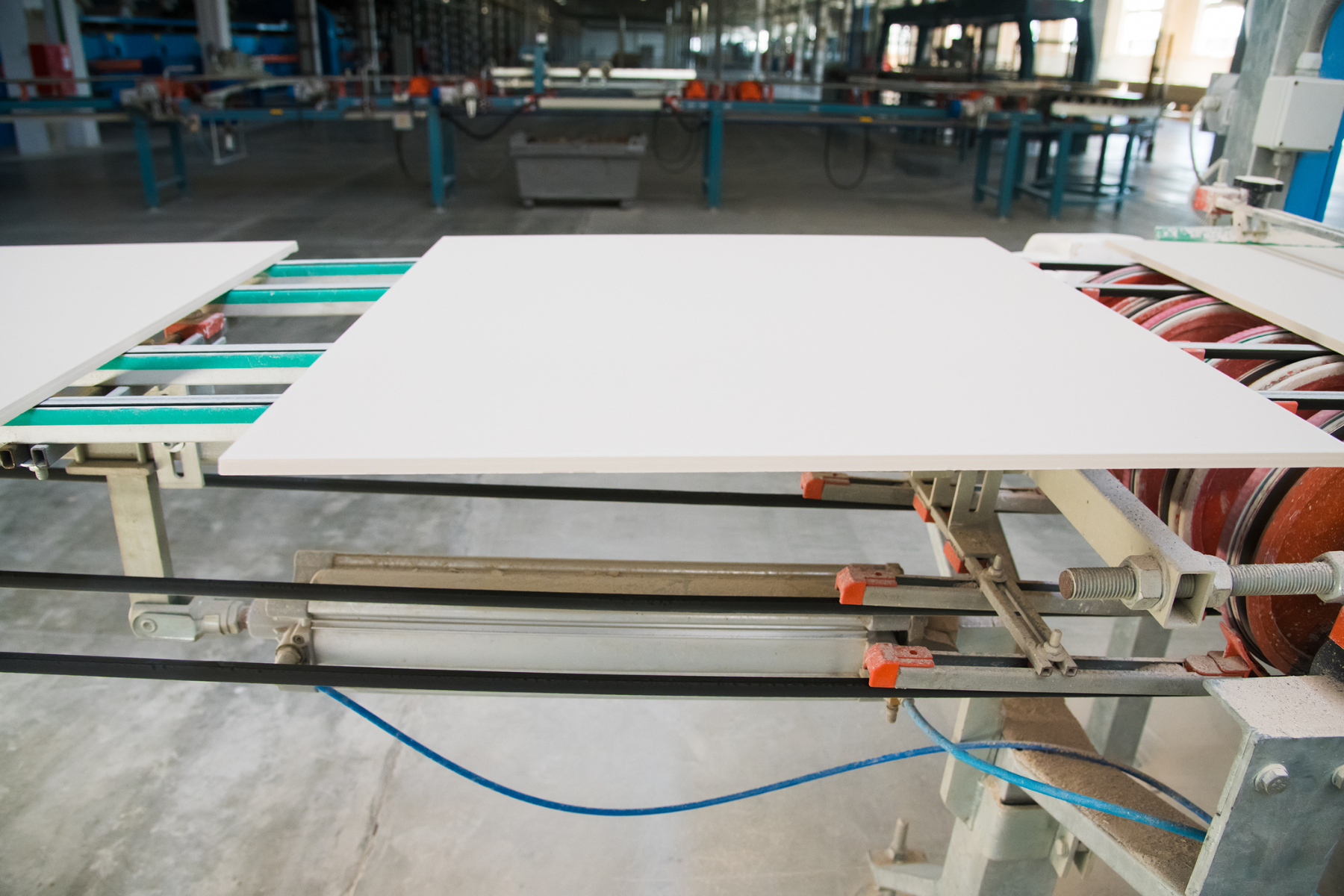
The dimensional stability of a ceramic tile does not begin in the kiln. It starts to be determined much earlier: at the press.
When a tile emerges from the mould with an uneven distribution ofapparent density, thickness or mass, this heterogeneity may not be visible to the naked eye. However, it is already determining how the tile will behave during drying, glazing, firing, rectification and final sorting.
In other words: many problems relating to thickness, curvature, flatness or misalignment do not appear spontaneously at the end of the process. In many cases, they begin to develop in the green body and manifest themselves later during drying, firing or post-processing.
The the porosity of freshly pressed ceramicblanks influences the behaviour of the pieces during drying, glazing and firing, and largely determines final properties such as dimensions and curvature. Due to the difficulty of measuring this porosity directly, apparent density it becomes the physical parameter used to control the pressing stage.
In this article, we analyse howapparent density and dimensional stabilityare related, why internal variations lead to subsequent defects, and how X-ray inspection enables action to be taken before the defect progresses down the line.
Why dimensional stability begins before the kiln
On the production floor, it is common to associate dimensional problems with the firing process: temperature, thermal profile, position in the kiln, supports, rollers or stresses during sintering.
All these factors are important. But they do not act on a neutral piece. They act on a piece that already enters the kiln with a specific internal distribution of density, porosity, thickness and mass.
If that distribution is not homogeneous, the tile does not shrink uniformly.
The consequence is straightforward: two areas of the same piece may behave differently during drying and firing. One area may shrink more; another, less. One may generate internal stresses; another, maintain greater stability. The result can lead to loss of thickness, warping, buckling or twisting.
From a quality control perspective, this changes the approach: it is not enough to measure the piece at the end. We need to understand what is happening at the source.
What is bulk density in a pressed tile
Bulk density is ameasure that relates the mass of the tile to its apparent volume. In the case of pressed ceramic tiles, it is an indirect but fundamental indicator of the compaction of the atomised powder.
Given that the powder has the same composition and physical-chemical characteristics,the bulk density depends mainly on the pressing pressure and the moisture content of the powder. These parameters are usually represented by compaction diagrams, which are used to control the pressing operation.
In practical terms: a tile with a homogeneous bulk density is more likely to maintain stable behaviour during the subsequent stages of the process.
A tile with areas of varying density, on the other hand, may exhibit different behaviours even if it appears visually sound.
Variables influencing bulk density
| Process variable | Effect on the pressed piece | Risk if uncontrolled |
| Moisture content of the atomised powder | Affects compaction and subsequent shrinkage | Differences in shrinkage and stability |
| Pressing pressure | Determines the degree of compaction | Areas with low cohesion or over-compaction |
| Mould load | Influences mass distribution | Heterogeneity between areas of the part |
| Thickness | Affects X-ray absorption and apparent volume | Incomplete readings if not measured alongside density |
| Particle size distribution | Affects particle packing | Internal variations in porosity |
| Trapped air | Causes internal discontinuities | Lamination, flaking or fractures |
In practice, the aim is not merely to achieve an adequate average density. The real challenge is to achieve a uniform distribution of density throughout the entire part.
From bulk density to gauge: the technical mechanism
The relationship between bulk density and dimensional stability can be summarised in a very clear sequence:
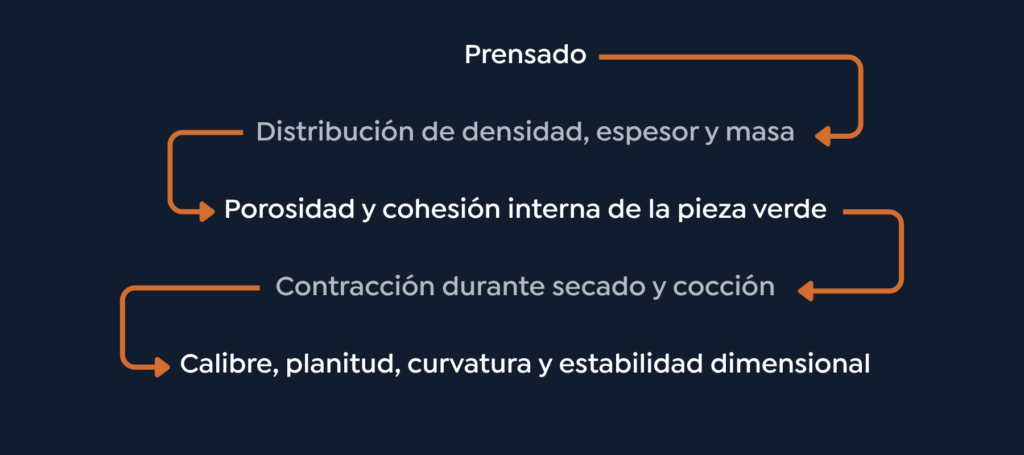
When compaction is not uniform, areas of higher or lower density appear. This difference affects the behaviour of the piece during drying and sintering.
Technical studies on dimensional stability indicate that, for a given composition, post-pressing expansion and drying shrinkage depend on the moisture content of the powder and the maximum compaction pressure, whilst firing shrinkage depends mainly on the dry bulk density and the maximum firing temperature.
Therefore, the final size of the tile does not depend on a single parameter. It depends on how the variables of pressing, drying and firing interact.
Conceptual diagram: how a variation in density leads to dimensional defects
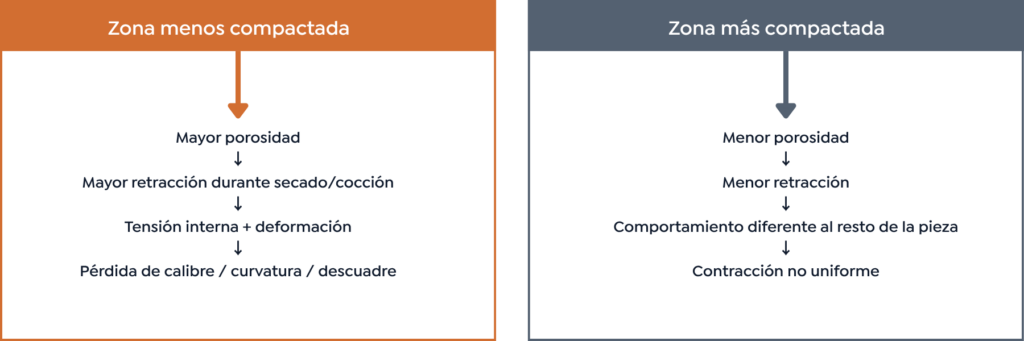
The problem is not that an area has higher or lower density in isolation. The problem is the difference between areas.
Main dimensional defects associated with poor density distribution
Internal differences in density can cause various defects in subsequent stages. Some appear during drying. Others become apparent during firing, grinding or grading.
| Heterogeneity detected in the green body | Subsequent mechanism | Visible or measurable defect |
| Areas of lower density | Increased shrinkage during firing | Loss of gauge |
| Irregular distribution of mass | Non-uniform shrinkage | Dimensional misalignment or dispersion |
| Differences in compaction between areas | Internal stresses | Curvature or helical warping |
| Localised low compaction | Lower mechanical strength | Breaks during handling or grinding |
| Trapped air or laminations | Structural weakening | Pitting, delamination or breaks |
| Uneven porosity | Different interaction with engobes/glazes | Possible shadows, stains or differences in tone |
Thickness, flatness and curvature: three indicators of the same problem
Dimensional problems are often analysed as separate defects. However, in many cases they share a common cause: a non-uniform distribution of bulk density.
Loss of thickness
Loss of thickness occurs when the fired piece does not reach the expected dimension or when there are dimensional differences between pieces from the same batch.
If the dry bulk density is not stable, the firing shrinkage will not be completely stable either. This can lead to dimensional variation and complicate automatic grading.
Curvatures
Curvatures can occur when different areas of the tile contract at different rates. In conventional formats, a small deviation may be acceptable. In large formats, that same deviation can be magnified and result in a critical defect.
The following types may be encountered:
| Type of deformation | Description | Possible cause |
| Longitudinal curvature | Deformation along the length of the tile | Uneven contraction between the ends |
| Transverse warping | Deformation across the width | Differences in density between bands |
| Tile with helical warping | Tile torsion | Cross-cutting internal stresses |
| Loss of flatness | General surface deviation | Irregular distribution of mass and density |
Out-of-square
Misalignment occurs when the piece loses its orthogonality. In this case, density heterogeneity can cause non-uniform shrinkage in different directions of the piece.
The result is not always a break or obvious curvature. Sometimes it is a more subtle problem: pieces that do not fit correctly during sorting, installation or rectification.
Why large-format tiles increase the risk
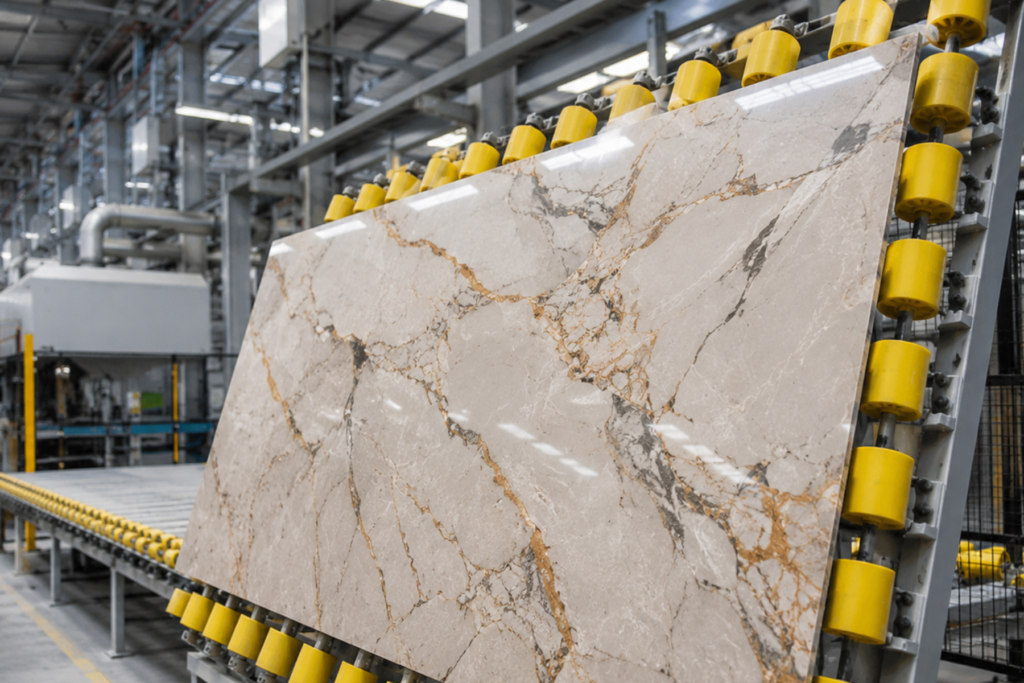
With large-format tiles, dimensional stability is even more critical.
A localised variation in density can have a greater impact because it affects a larger surface area, with greater distances between support points, increased sensitivity to internal stresses, and a higher cumulative value in each unit produced.
Furthermore, large-format production often involves stages where the cost of defects increases: drying, glazing, firing, grinding, cutting, packaging and logistics.
Detecting a dimensional problem at the end of the process allows the piece to be sorted. But it does not prevent the consumption of energy, kiln time, glaze, line capacity and handling resources.
That is why, in large-format production, in-process inspection is not merely a quality improvement. It is a direct tool for productivity.
How X-ray inspection helps anticipate dimensional problems
The X-ray inspection enables a shift from spot measurement to a comprehensive analysis of the piece.
X-ray absorption technology enablesthe determination of the distribution of bulk density within materials in a non-destructive manner. Its principle is based on the absorption of radiation as it passes through the material, where chemical composition, thickness and bulk density all play a role.
In the case of pressed ceramic tiles, this technology enables the creation of maps showing the distribution of bulk density, thickness and load for the inspected piece. With this technology, it is possible to measure 100% of the piece’s surface area using over 1,000 measurement points per square centimetre, reducing testing time by up to 90%.
This offers a key advantage: we do not merely know whether a piece has the correct average density. We can see how that density is distributed across the entire surface and detect critical areas before firing.
From technical data to production improvements
Controlling apparent density in the green state enables action to be taken on three levels of improvement:
1. Quality improvement
A more homogeneous distribution of density reduces the risk of differential shrinkage, warping, misalignment and loss of gauge.
2. Productivity improvement
When a deviation is detected at the press, the technical team can take action before producing entire batches with the same defect. This is particularly relevant during format changes, model adjustments or large-format production.
3. Cost savings
Every defective tile that makes it as far as the kiln incurs costs: raw materials, energy, glaze, line occupancy, handling and time. Preventing a tile with a structural defect from reaching higher-value stages reduces the cost of poor quality.
Apparent density is not just a laboratory figure. It is a critical variable for predicting how a tile will behave during the ceramic process.
That is why true dimensional control begins at the press.
Measuring the apparent density of the green body, visualising its distribution and correlating it with subsequent behaviour allows decisions to be made before the kiln, the process to be adjusted more precisely and wastage in higher-value stages to be reduced.
At Tekinn, we help ceramic plants to reveal what the piece does not yet show on the outside: its internal distribution of density, thickness and mass.
Would you like to check how the bulk density is distributed in your pieces before firing?Request a no-obligation demo.