

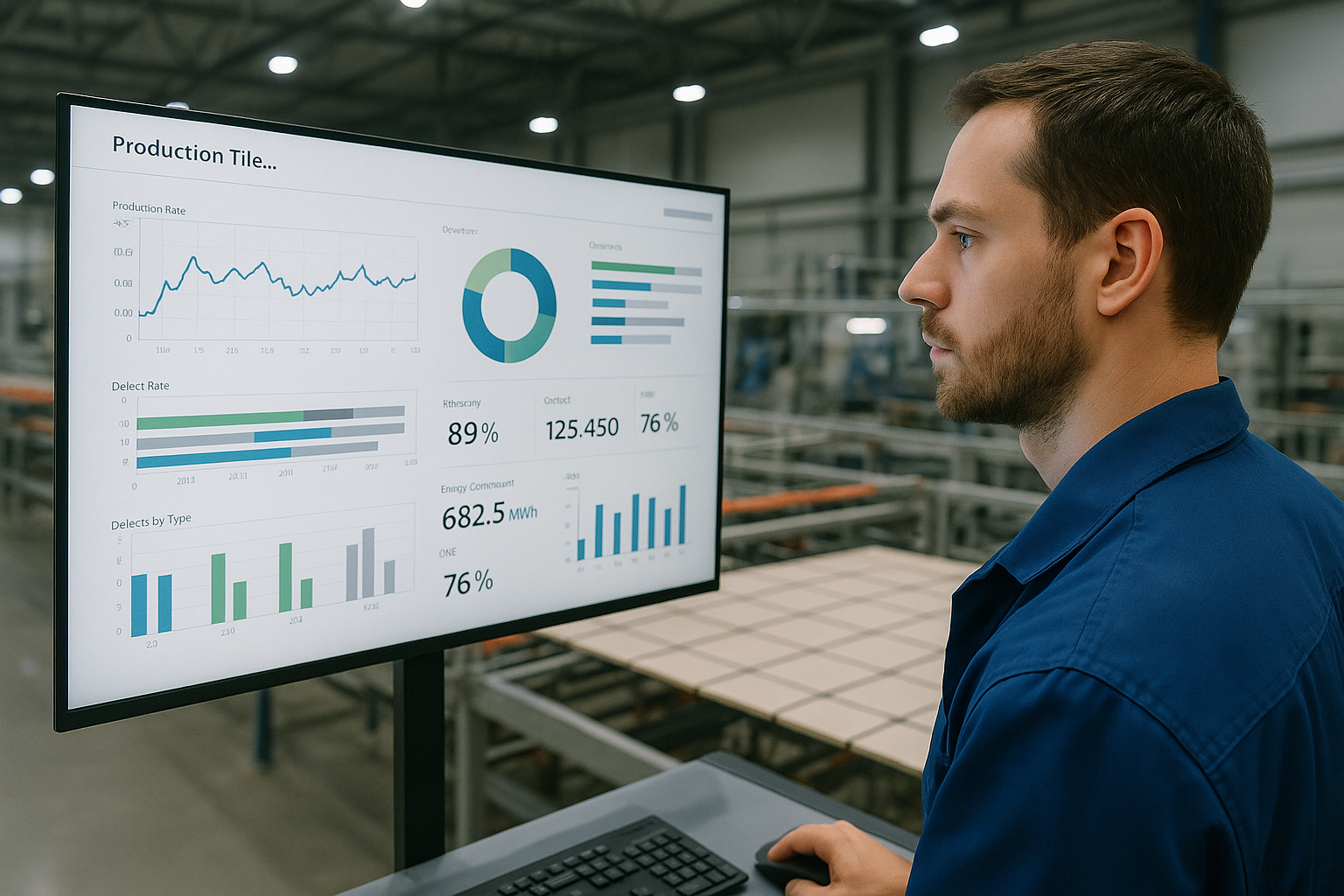
In the ceramics manufacturing sector (and in most others), where margins for improvement are becoming increasingly narrow and competition is intensifying, the difference between an efficient and an inefficient production facility does not always lie in the production machinery—which is equally accessible to everyone—but rather in the quality of the information that is gathered and used to make decisions. A factory that measures well makes better decisions. And making better decisions means producing more, with higher quality, and less waste.
Beyond the data: the value of contextualized information
It’s not just about collecting data, but about collecting the right data—as accurate and complete as possible—and doing so quickly, to help technicians make informed decisions. Many factories already have sensors and computer systems that generate large volumes of data. The problem arises when that data is disconnected from the context of the production process, is unreliable, or isn’t available at the right time. An in-depth preliminary analysis is necessary to assess what data to collect, how to process it, and how to act based on that information. Only then can we proceed with greater confidence.
Throughout the entire ceramic tile manufacturing process, each stage offers opportunities to capture key data: atomization variables, pressed product parameters, variations in product moisture or temperature during production, traceability, energy consumption, visual defects, downtime, rejects… But without a strategy for data acquisition, filtering, correlation, and analysis, that data may, in practice, remain invisible or unused.
Decisions based on evidence, not on intuition
For years, many decisions on the production floor have been made based on the experience of technicians. And while that experience remains valuable and essential, it is no longer enough today. The speed at which processes must be adapted to new doughs, shapes, or finishes—combined with production runs that are sometimes very short—requires a more agile and precise response. Only useful, real-time information allows for appropriate decisions to be made regarding, for example:
- Detect deviations before they lead to nonconformities.
- Analyze the root causes of quality issues.
- Optimize energy consumption without compromising production.
- Establish truly effective predictive maintenance plans.
- Compare shifts, lines, or batches objectively and continuously.
From information to operational intelligence
It’s not just about digitizing the factory; it’s about making it smarter. We already have various systems and solutions designed specifically for the ceramics industry that enable us to capture high-value data and transform it into valuable insights. For this to happen, these data-capture systems must be able to communicate with one another and feed information into a central hub that analyzes and integrates it effectively for use by a technician or an automated control system.
For our part, we can cite the example of our TEKINN XDS systems, which provide highly valuable information about the stamped part. This information can be analyzed or made available to other central information systems, where it is correlated with process variables and final quality indicators, helping to establish patterns and predict product behavior and defects before they occur. This avoids a reactive approach and moves toward predictive management.
The real impact: improved productivity and quality
Improved decision-making based on reliable information has direct and measurable impacts, such as:
- Reduction in waste, rework, and unplanned downtime.
- Increase in production capacity.
- Improvement in the top-quality index.
- Improved energy efficiency.
Let’s envision factories of the future that have a clear and robust strategy for investing in modern machinery—not only for production, but also for data collection and process information analysis. Factories that leverage this information with the utmost efficiency and effectiveness to make intelligent decisions. Factories that are firmly committed to the principle that the quality of the information we obtain determines the quality of the decisions we make. This will undoubtedly lead to greater profitability and, therefore, improved global competitiveness for the company—something that is so essential today for survival and continuous improvement.
Ramiro Bonaque
CEO of Tekinn Engineering Solutions S.L.