

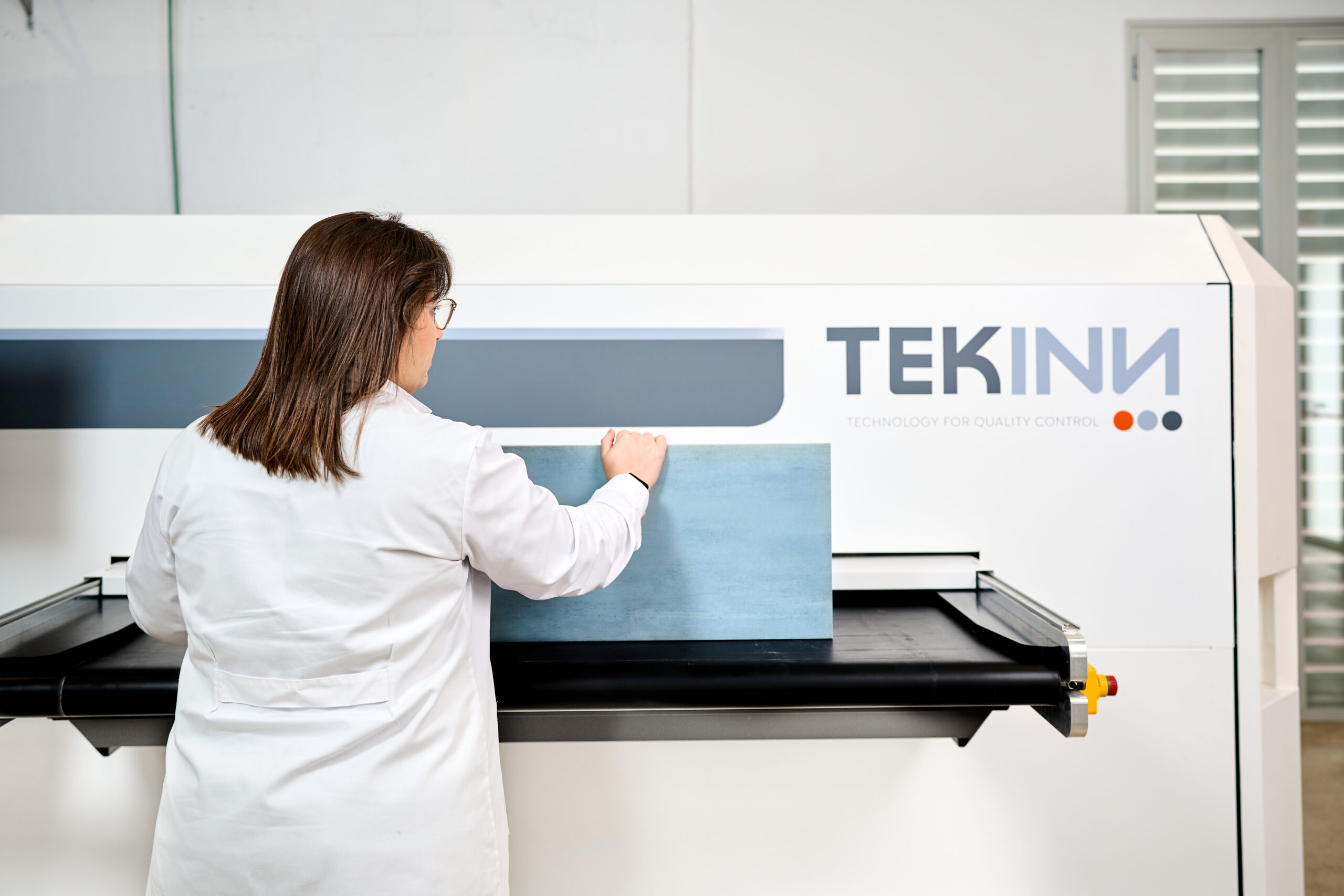
The manufacture of ceramic floor and wall tiles is a complex, continuous and highly interdependent industrial process. Its primary aim is to produce materials for covering surfaces that meet increasingly demanding technical and aesthetic requirements. In the current climate, marked by the emergence of large format, a manufacturing defect is not merely a cosmetic flaw; it is a critical fault that directly undermines the plant’s operational profitability.
Modern quality management has had to evolve in response to the growing competitiveness of the ceramics sector. It is no longer viable to maintain a purely corrective approach, where quality control takes place after firing. The sector is undergoing a paradigm shift towards a comprehensive strategy of preventive control at source. Understanding the technical root causes of each issue – from the physics of the clays to the thermodynamics of the kiln – is the first step towards minimising waste and optimising energy efficiency, a commitment that defines we at Tekinn.
Definition and classification of ceramic defects
Within the context of ISO standards and industrial quality standards, a defect is defined as the absence or deviation of a product’s characteristics from a previously established reference standard. This deviation may manifest itself in dimensional, mechanical or visual terms, and managing it requires a dynamic approach.
Technical classification criteria
To carry out a rigorous analysis that enables continuous improvement, we must categorise defects according to four key criteria:
- By their very nature:
- Visual defects: These affect the surface finish (stains, pores, scratches).
- Dimensional defects: These alter the geometry and dimensions of the piece.
- Mechanical defects: These compromise structural integrity (fissures, cracks, breaks).
- By severity:
- Critical: Those that result in immediate rejection or breakage of the piece on the production line.
- Major: These affect commercial grading, downgrading the product to second or third grade.
- Minor: Slight deviations which, although they do not render the product unusable, reduce its perceived value.
- By origin: t is vital to identify whether the root cause lies in pressing, drying, glazing or firing. Rarely does a defect stem from a single cause; it is usually the interaction of multiple variables (raw materials, machinery, human factor).
- By frequency: We distinguish between systematic defects, arising from a fault in the process configuration, and sporadic defects, caused by a one-off variation in the raw material or energy supply.
Pressing: The critical origin of ‘Tile Pathology’
As the technical and scientific evidence compiled by Tekinn clearly shows, the pressing stage is the ‘moment of truth’ that determines the structural integrity of the piece. In this phase, the distribution of density-thickness-mass is the most critical factor in ensuring the cohesion of the ceramic body. If the tile is born with a defect in the press, no subsequent process can correct it; it can only mask the symptom until the fault becomes irreparable.
Variations in bulk density
Compaction must be perfectly uniform across the entire surface of the green body. Where there are variations in bulk density, this leads to inconsistencies in mechanical strength, which are the cause of the most costly shrinkage defects. To mitigate this, it is essential to have advanced product inspection systems.
Areas of low density act as weak points, leading to:
- Drying cracks: heterogeneity in compaction increases the likelihood of drying cracks, ultimately caused by moisture gradients, high drying rates or uneven heat application.
- Absorption differences: Variable density alters porosity, which directly affects the evenness of the glaze layer and ink absorption in digital decoration.
- Firing breakages: differences in density cause inconsistencies in the mechanical strength of the fired piece, which can lead to breakages during handling of the final product.
Trapped air: Laminations and ‘Ahojados’
One of the most insidious defects and one of the hardest to detect using traditional methods is air trapped during the pressing cycle. If the de-aeration process is not optimal — due, for example, to a deficient de-aeration cycle during pressing or an inappropriate particle size of the atomised material — air becomes trapped within the core of the body.
This phenomenon causes the separation of internal layers known as laminations. As they are invisible to the naked eye and to optical systems, these defects can go unnoticed and lead to cracks or bulges in the kiln. In large-format parts, these laminations may remain latent until the grinding process, where the sudden release of internal stresses fractures the finished part. Identifying these causes in the raw material is the cornerstone of our Zero Point methodology.
Geometric and dimensional stability defects resulting from poor pressing
Loss of flatness and dimensional drift represent the main technical challenge in the production of large slabs (Slabs). These defects are not random; they stem directly from the physical laws governing sintering and the associated ceramic shrinkage.
Curvature and loss of flatness
During firing, the ceramic piece undergoes volumetric shrinkage. If the density in the press was non-uniform, the areas with lower density will shrink more than the more compact areas. This differential behaviour is directly responsible for:
- Surface curvature (flatness) and edge curvature (warping): Which prevent compliance with the strict ISO standards required for correct installation on site.
- Other complex warping: resulting from asymmetrical stresses combined with inappropriate kiln cycles, which render the piece unsuitable for any high-level architectural use.
Dimension and dimensional variations
A lack of uniformity in the mass fed into the mould (caused, for example, by dirt on the screen, poor feeder adjustment, or an uneven particle size distribution of the paste) means that, after passing through the oven, parts from the same batch exhibit varying sizes and misalignments. This loss of gauge complicates automatic sorting and drastically increases the rejection rate on the trimming lines, where more material must be removed to level the pieces, with the consequent additional costs in tools and processing time.
The process after pressing: from the drying room to trimming
Drying and Glazing Stage
In the drying oven, the part loses its forming moisture. Defects here are usually stress cracks. Subsequently, during glazing, the interaction between the substrate and the coating materials is critical. If the porosity of the substrate is not consistent due to poor prior compaction, bubbles, pinholes, craters or a lack of uniformity in the surface finish may appear, ruining the product’s aesthetics.
Firing and Cooling
Firing is the consolidation stage, but it is also where ‘defects’ acquired in earlier stages become apparent. During preheating, residual moisture that has not been properly removed can cause mechanical explosions. At the peak temperature, pyroplastic deformations occur due to overfiring. Finally, poorly controlled cooling leads to ‘de-venting’ or cracking, defects caused by thermal shocks that exceed the structural strength of the tile.
Towards a new methodology: Zero-Point Inspection
Traditional defect analysis has historically been reactive: the product is manufactured, fired and then sorted. This model is unsustainable in the era of energy efficiency. In an Industry 4.0 environment, X-ray technology allows quality control to be moved to the start of the process, where the cost of discarding a piece is minimal.
The value of volumetric X-ray inspection
Unlike optical or laser vision systems, which can only analyse the ‘surface’, Tekinn X-Ray technology (backed by the scientific expertise of the ITC) performs a complete ‘X-ray’ scan of the green tile.
This volumetric capability offers unprecedented competitive advantages:
- Preventive detection: It clearly and quickly identifies potential laminations, inclusions and density variations before the part consumes gas in the furnace.
- Massive cost savings: Prevents the waste of energy, glazes and inks on pieces that are already structurally compromised upon leaving the press.
- Real-time optimisation: Data on mass and thickness enables the technical team to adjust the press’s pressure and load parameters immediately, based on empirical evidence rather than trial and error.
Data integration for continuous improvement
Defect analysis in the ceramics industry should not be approached in isolation. Operational excellence is only achieved through an integrated approach that combines traditional sorting with advanced inspection systems and historical data analysis.
In the era of large formats and sustainability, competitiveness lies in ceramic expertise applied to inspection technology. Zero-defect control is no longer an optional technical improvement but has become the new standard of efficiency for the global industry. If you would like to carry out a technical audit or find out how to implement these solutions in your plant, please do not hesitate to contact Tekinn. Prevention is, now more than ever, the key to ceramic profitability.